A Complete New Business Pitch & Comms Suite in Under 1 Hour: Testing Claude Skills & Projects
How I built a brand skill from scratch and produced a full campaign toolkit – speaking proposal, presentation, content calendar, outreach emails – in a single session.


How I built a client pitch from scratch and produced a full campaign toolkit – speaking proposal, presentation, content calendar, outreach emails – in a single session (and doing so in a very meta fashion...). Every asset is shared below.
I receive cold pitch emails every day, and I bet you do too. Most are painfully generic – the same templated approach sent to hundreds of prospects, hoping something sticks. They take seconds to delete because they clearly took seconds to create.
However, what if the economics of tailored outreach could change entirely?
To explore the current capabilities of Anthropic's Claude features – Skills and Projects in particular – I decided to test how they could transform cold business development from a numbers game into something genuinely personalised – and whether I could create a complete, production-ready pitch toolkit within the space of a lunchtime.
- The target: Supporting Faur* at DataFest 2026, Scotland's premier data and AI festival (27-28 May in Edinburgh), providing a comprehensive initial marketing and communications suite for this potential new client, as well as materials to secure a speaking slot at the event for its founder.
- The approach: build everything from scratch in a single session, including the brand guidelines that would inform every asset.
- The result: A speaking proposal, presentation deck, content calendar, outreach emails, and an advisory note. All assets shared below, completely unedited from what Claude produced.
- The required resource: 90 minutes elapsed time – under 60 minutes of active work, with gaps while Claude processed larger documents. I'm on its $20/month Pro plan, and also occasionally had to wait a couple of times as I'd maxed out its usage limit through using its 'most capable' Opus 4.5 model, with it resetting around 5 hours later.
Faur is my own company, so in essence, I was hypothetically creating this as a cold approach from someone who hadn't spoken to us before. A bit meta, though also a fun way to judge results.
What Are Claude Projects and Skills?
For readers unfamiliar with these features: Claude Projects let you create persistent workspaces where you can upload reference documents, set custom instructions, and maintain context across conversations. Rather than re-explaining your brand, your objectives, or your constraints every time, you brief Claude once and it retains that knowledge.
A "Skill" takes this further – it's essentially a structured set of instructions that tells Claude how to approach specific tasks, and which is stored within the platform for recurring use by Claude itself. For this experiment, I built a brand skill for Faur that specified typography, colour palette, voice principles, and formatting preferences – and did so by asking Claude to create this through looking at the Faur website. This process took a few minutes, then a few more since it hadn't realised the right fonts, which I screengrabbed and located through a free online tool. (Of course, I already knew these, but ignored my own pre-existing knowledge in the interests of the test.) It first created a Word doc, which I then asked to save as a Skill.
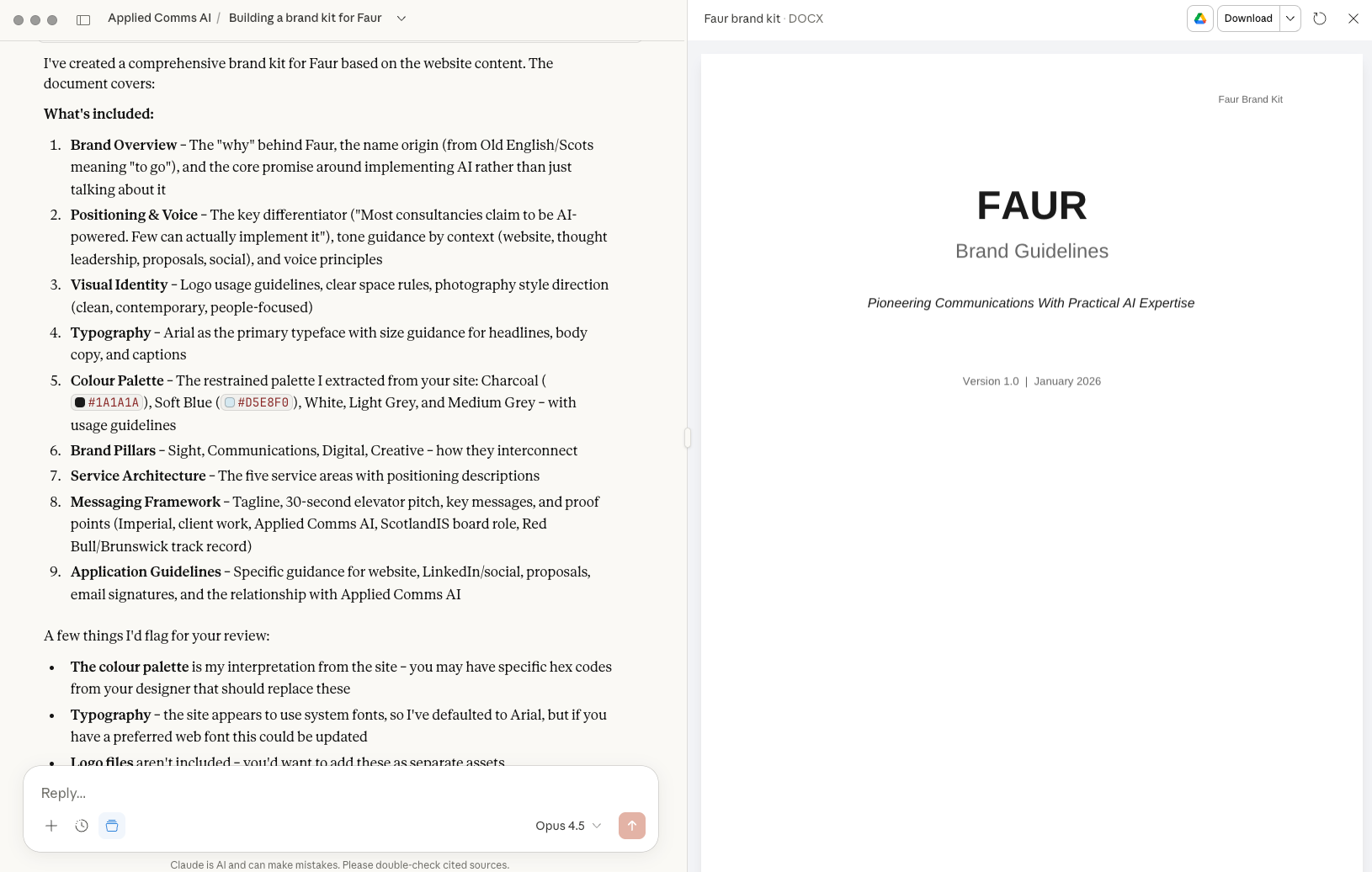
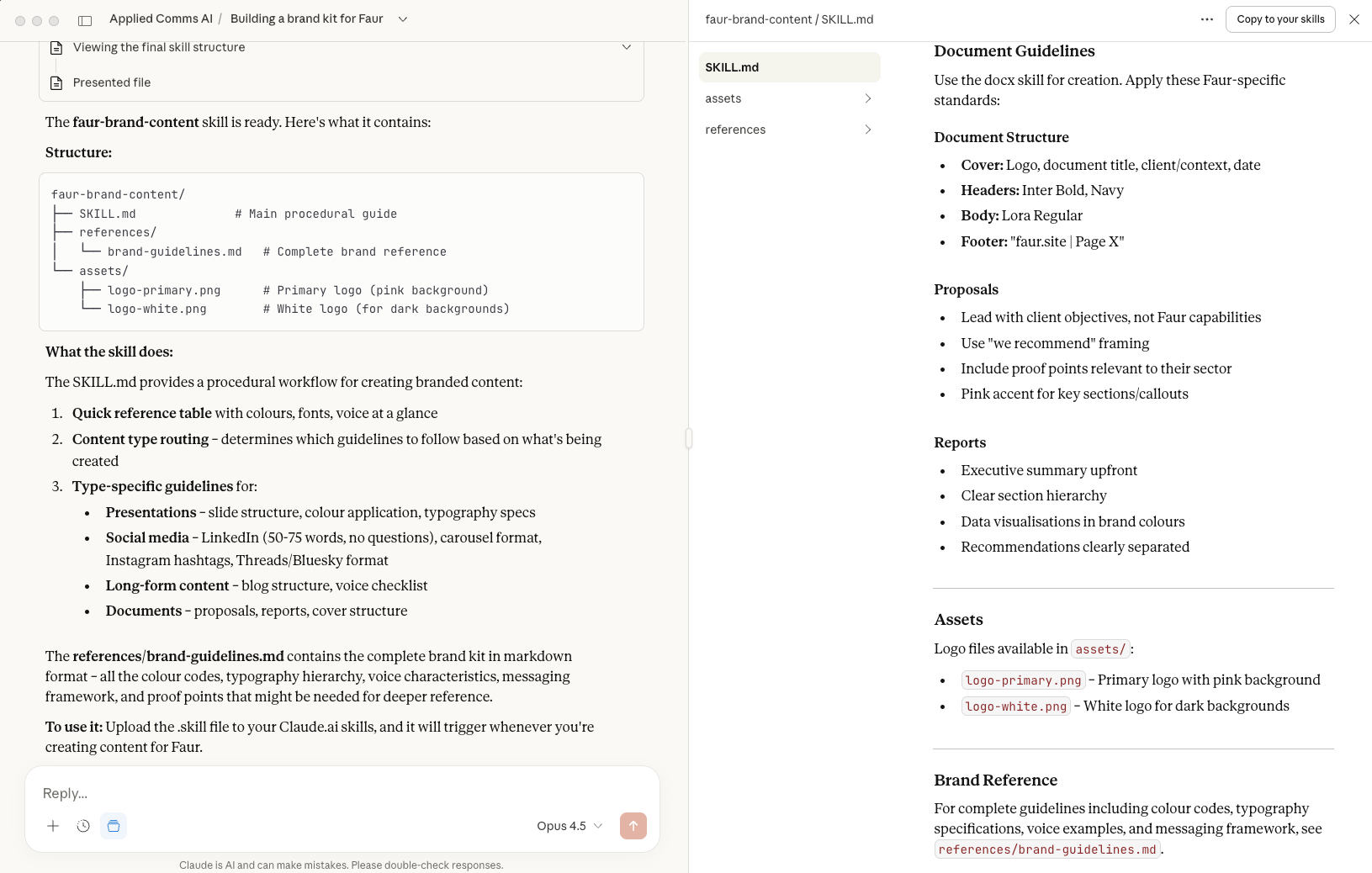
The front-loaded investment in creating these instructions promises to pay dividends across every asset produced within the project, and certainly did so in this case.
The Experiment Setup
I set myself a genuine challenge: create a complete pitch toolkit for DataFest 2026 that I could actually provide to Faur alongside a work proposal, and could myself then use. (So thinking about this as not just a hypothetical exercise, but real materials for a real opportunity.)
The session included:
- Building Faur's brand Skill in Claude from scratch, and then a complementary Folder for further work (transferring the main conversation with Claude there once ready)
- Researching DataFest (dates, themes, partnership options, The Data Lab's positioning)
- Developing strategy (why Faur should be there, what angle to take)
- Creating the full suite of assets
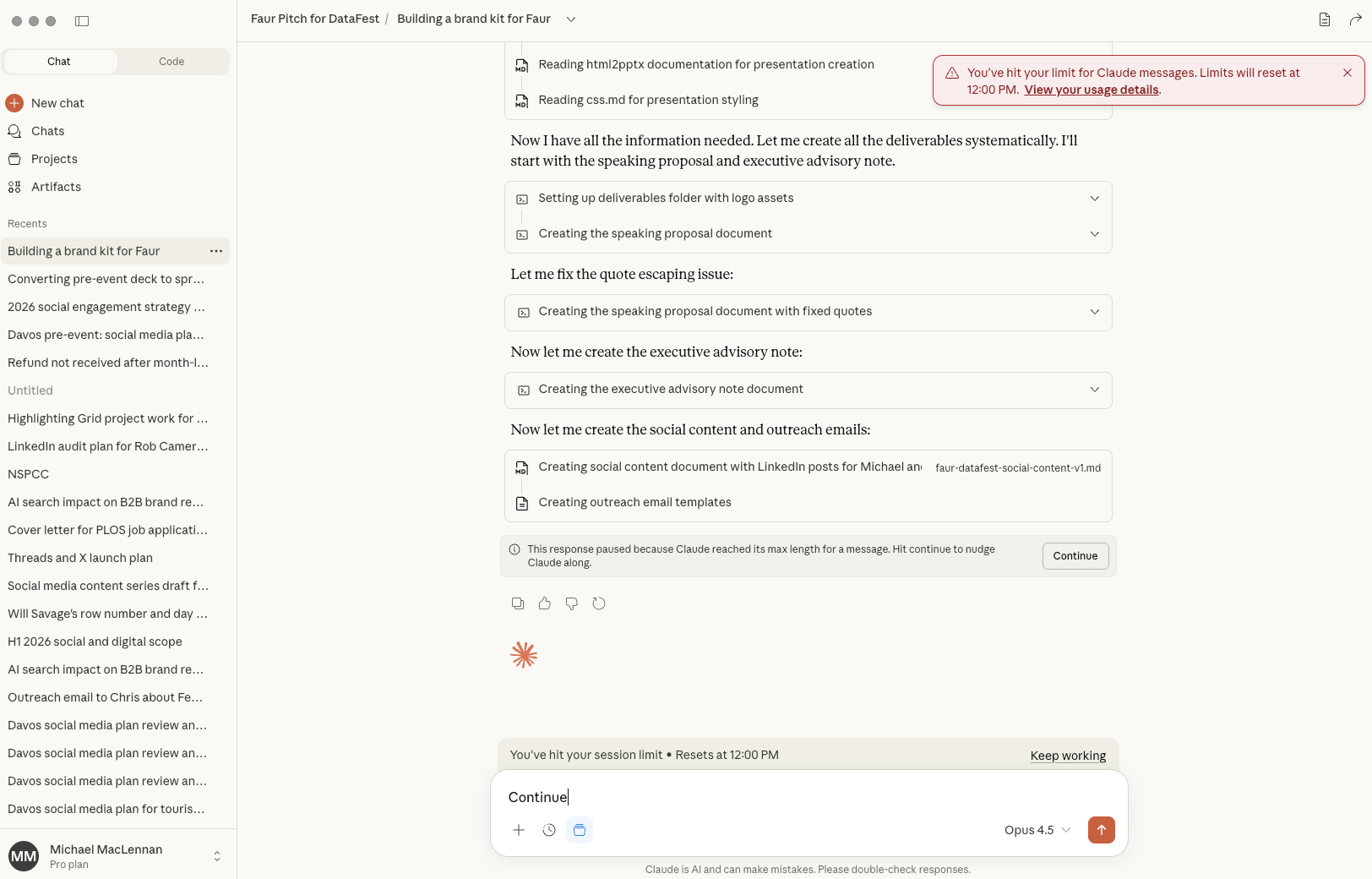
Everything happened in a single conversation. In hindsight, I'd approach future projects differently – creating the brand skill first, then using separate conversations within the project folder for each major deliverable. But testing the single-session approach was part of the experiment.
What Got Produced (With Honest Assessment)
Here's what emerged, with my genuine evaluation of each output's quality:
1. New Business Pitch Overview
A concise strategic pitch setting out why DataFest 2026 is a strong opportunity for Faur, how AI-enabled workflows can be used to create a full, production-ready campaign in minimal time, and why this “show, don’t tell” approach reinforces Faur’s positioning as an implementation-led consultancy.
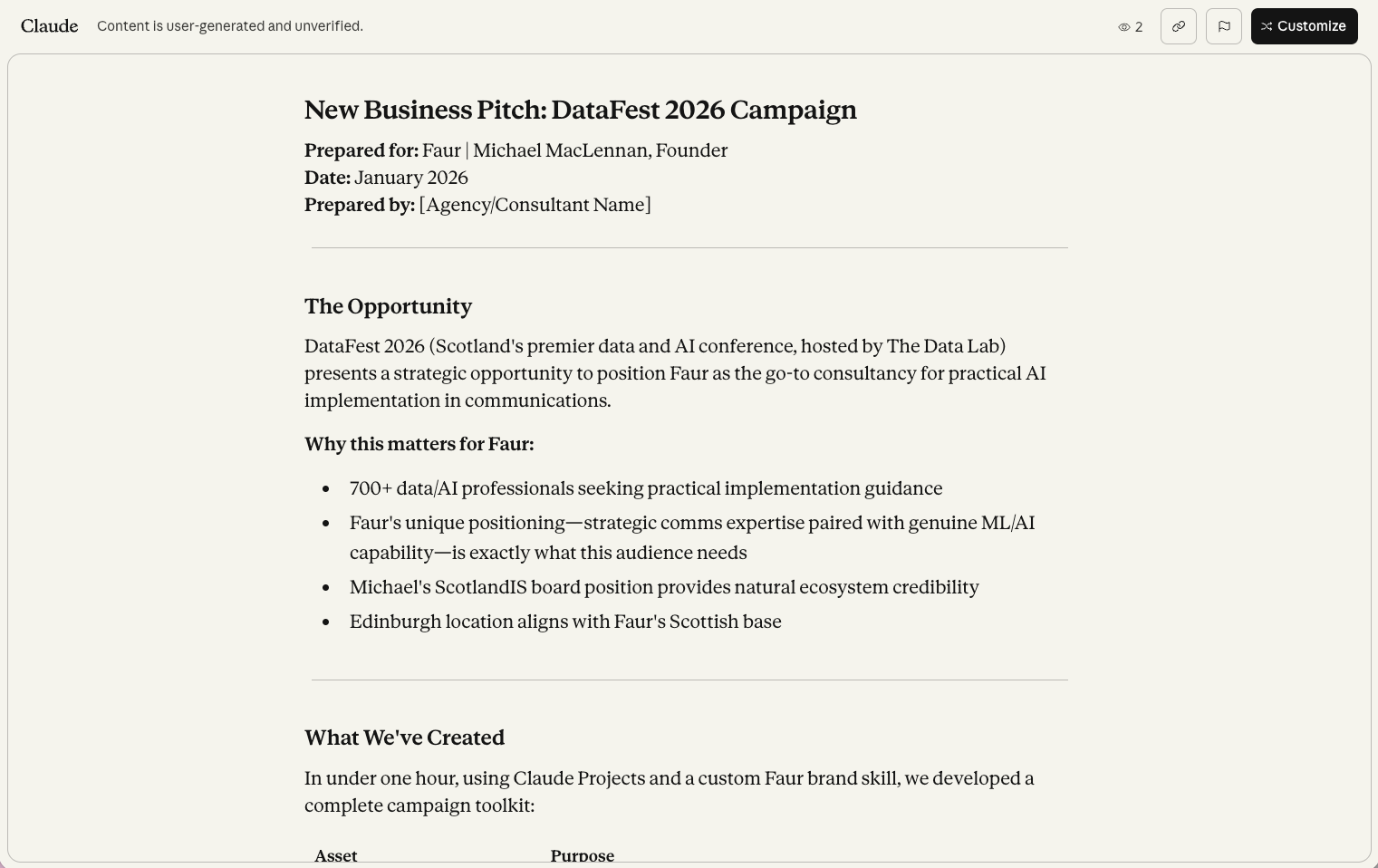
Quality: Decent. This was well structured and produced for what it was (hence receiving a high mark), but felt too much like an internal document – this was on me and my specification! In retrospect, I'd have produced an approach email to the client, tailored to grab their attention, before then providing some of this detail and a link to the rest of the initial 'What We've Created' suite.
2. Executive Advisory Note
A strategic document outlining why DataFest matters for Faur, the opportunity, risks, and recommended approach. The kind of thinking I'd normally do for a client considering a speaking opportunity.
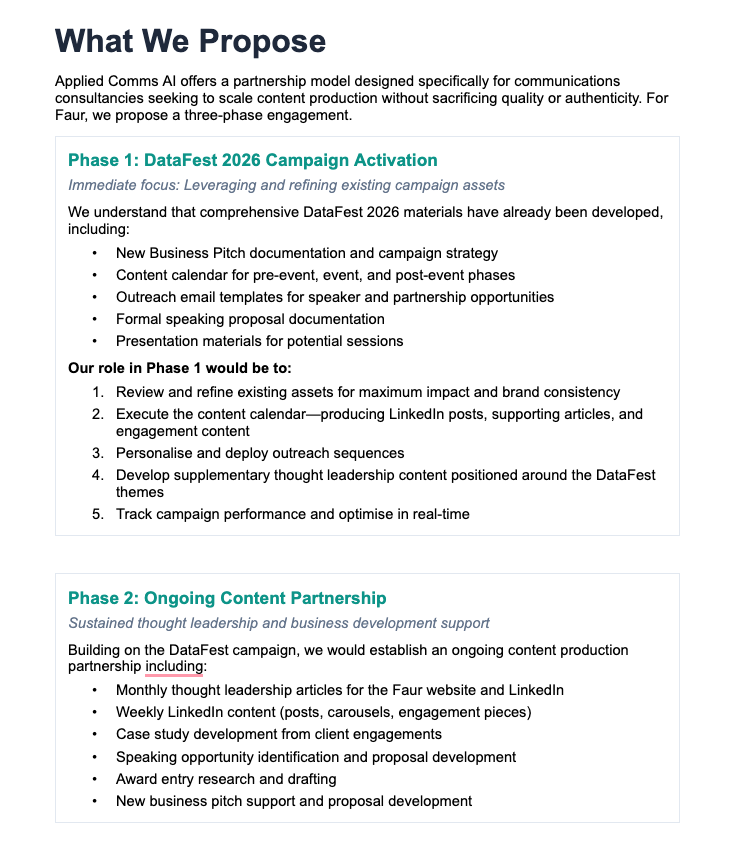
Quality: High. This needed light refinement rather than rewriting. The strategic thinking was sound and the framing matched how I'd approach the analysis.
3. Speaking Proposal to Provide to DataFest
A two-page document with session abstract, speaker bio, audience relevance, and technical requirements. Formatted with headers, pull quotes, and Faur branding.
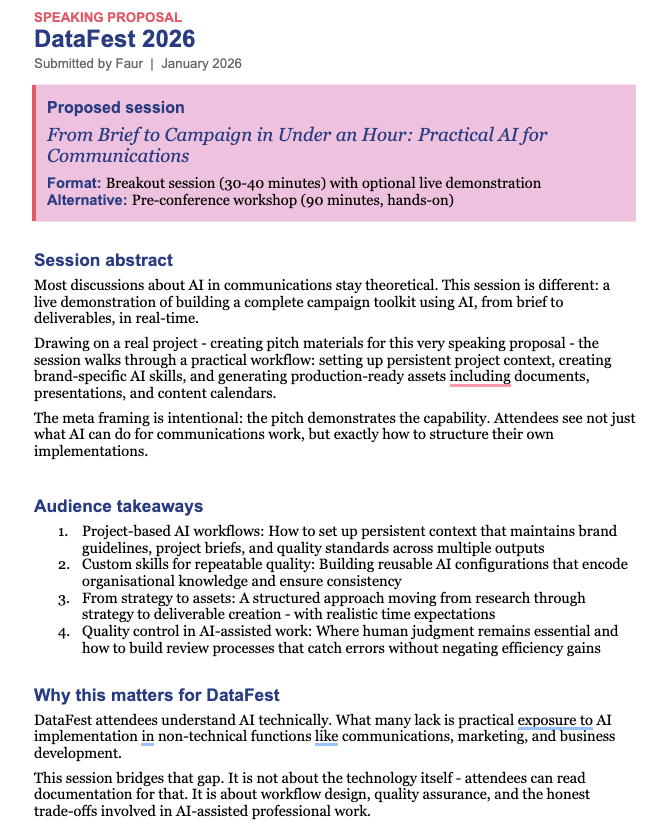
Quality: High. Again, refinement territory. The positioning aligned with what I'd have written manually, and the structure followed industry conventions.
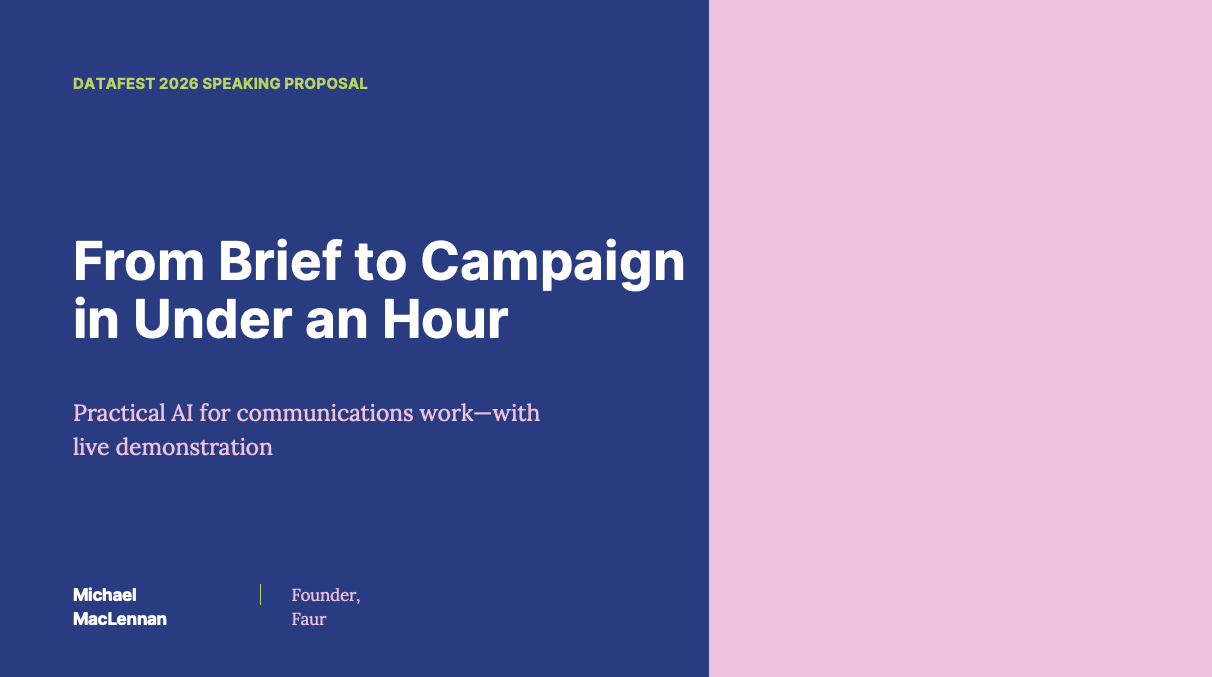
4. Presentation Deck
Twelve slides outlining how AI can transform communications workflows, designed to support the speaking proposal.
Quality: Poor. Here's where honest assessment matters most. The written content was strong – clear narrative, good structure, appropriate depth. But visually? Version 1 ignored the brand fonts entirely. I requested improvements for Version 2, which was better but still had stylistic problems. Not client-ready without significant design work.
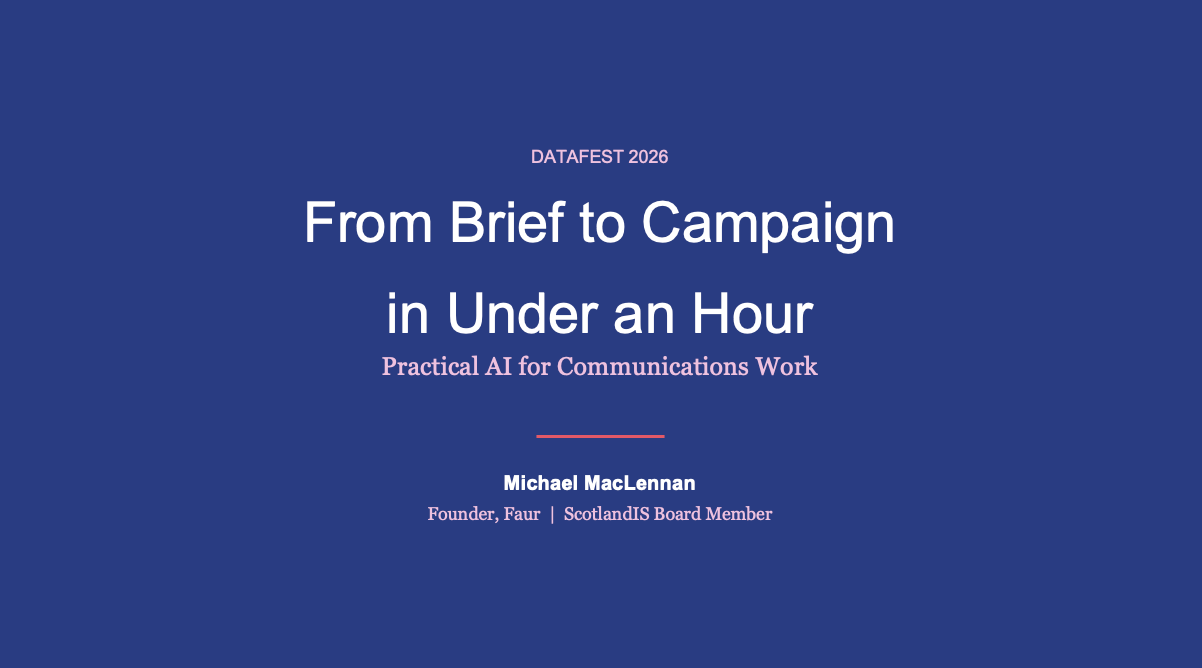
This matches my broader experience: Claude handles written content impressively well, but visual design remains a clear limitation.
5. Content Calendar
Twelve weeks of social media content across LinkedIn, Instagram, and Threads – covering pre-event thought leadership, event-day coverage, and post-event follow-up. Both company channel and personal profile versions.
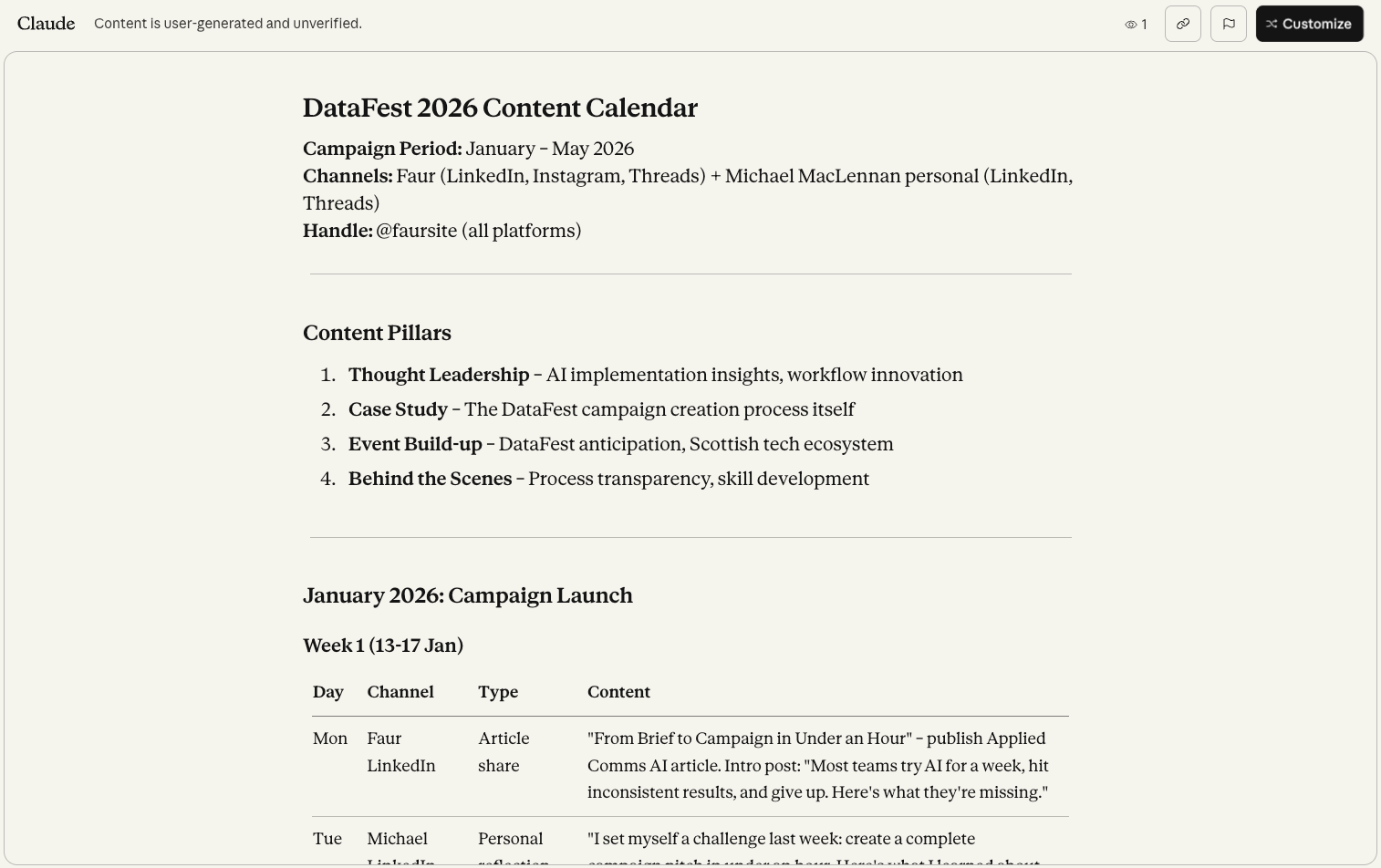
Quality: High. Comprehensive and immediately usable. The content themes aligned with Faur's positioning and the platform-specific formatting was correct.
6. Outreach Email
Ready to send to the DataFest team, referencing specific details about the event and making a clear case for the speaking proposal.
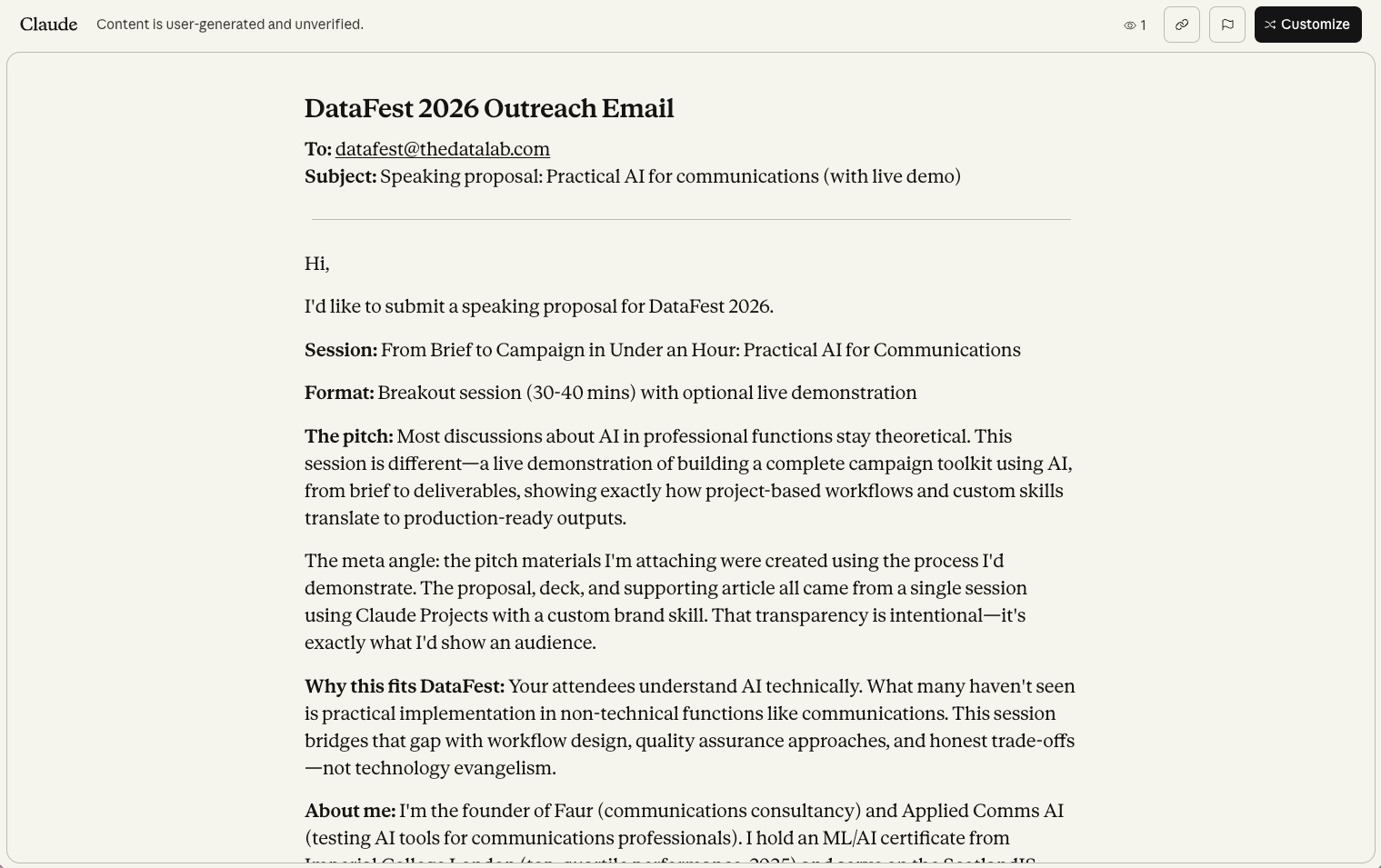
Quality: High. Personalised, professional, appropriate length. Not a generic template.
7. This Article! (First early draft)
Yes, asking Claude to produce an article documenting the process was part of the experiment. What you're reading is heavily edited but still based on the original draft, which you can find linked below for comparison. It was pretty solid, but there were elements – specifically Skills – which I wished to emphasise more, as well as providing more comprehensive analysis of performance and materials that the read could access and learn from.
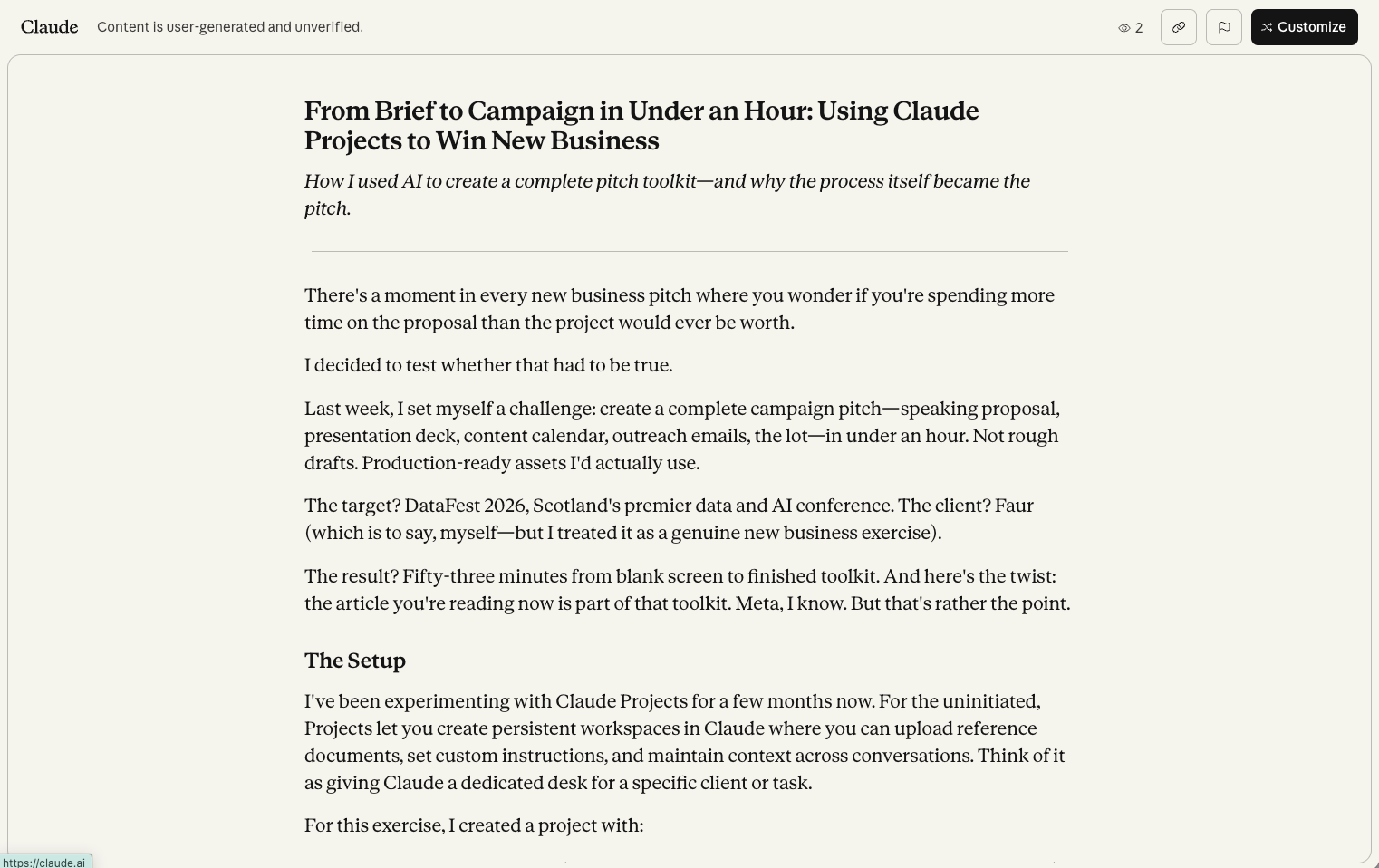
(Additional note: looking at the screengrab above, think I might actually prefer this intro, but rather than revert I'll let you be the judge...)
Additional Assets
View the Full Session Summary – Claude's own documentation of our conversation, useful for understanding the workflow.
Practical Implications
Some thoughts around what this ability and level of performance means:
- For business development: Comprehensively tailored outreach becomes economically viable, being achievable within minutes. Instead of choosing between generic volume and time-intensive personalisation, you can produce genuinely customised materials at scale. The cold emails clogging your inbox exist because personalisation was too expensive. That calculation has changed.
- For campaign development: The same project-based approach works for any client or initiative. Build the brand Skill once, create a dedicated project folder, then produce consistent assets across multiple deliverables. What previously took days might take hours.
- For quality control: AI doesn't mean AI-approved. Every output would need review and refinement before proper client presentation. Written content required refinement; visual design required significant work. But refinement is faster than creation. The 90-95% quality on written assets means starting from a strong foundation rather than a blank page.
- For workflow design: My single-conversation approach worked, but wasn't optimal. Better practice: create your brand Skill, then use separate conversations for each major deliverable within the project folder. You maintain context while keeping individual tasks focused.
Try This Yourself
The approach is replicable:
- Create a Claude Project for your client or initiative
- Build a brand Skill covering voice, visual identity, key messages, and formatting preferences. Ideally use existing brand guidelines, but if unavailable you can provide existing assets (such as a website, graphics, other content) to Claude and use that as a foundational base
- Upload reference documents – add existing content, brand guidelines, relevant research, etc as files to your project folder
- Set project instructions outlining your objectives and deliverable specifications
- Work systematically – strategy first, then assets, reviewing and refining as you go
The time invested in setup pays dividends across all outputs. And unlike traditional pitch work, the assets have multiple uses: the content calendar works regardless of whether DataFest accepts the proposal; the presentation adapts for other speaking opportunities; the article serves Applied Comms AI independently. The pitch becomes inventory, not overhead.
Next Steps
I'll be reviewing the developed materials – as a punter rather than as a creator – in advance of attending DataFest on 27-28 May. If you're there, let's connect!
And if you're interested in implementing similar approaches for your organisation, I'm opening up to new consultation work in Q1 2026. Whether that's building custom project workflows, running AI implementation workshops, or auditing your current communications processes, get in touch.
Michael MacLennan is the founder of Faur, a communications consultancy, and Applied Comms AI, a platform testing AI tools for communications professionals. He holds an ML/AI certificate from Imperial College London and serves on the board of ScotlandIS.