The Honesty Gap: Ben Verinder on AI, PR and Trust
Ben Verinder has researched AI in public relations for eight years. In this Applied Comms AI Leader Interview, he explains why the policy gap everyone talks about sits on top of a deeper one: an honesty gap between teams, agencies and the people they serve.


Ben Verinder has spent eight years researching what AI means for public relations, long enough to be wary of anyone who claims certainty about it. He is co-editor of AI for Public Relations , published this month by Kogan Page, an agency founder, a strategic communications adviser, and one of a small group of Founding Chartered PR practitioners globally. When Ben talks about AI, it is from evidence rather than enthusiasm. The argument he kept returning to in our conversation was not the policy gap the profession has learned to discuss, but a deeper one beneath it: an honesty gap, between teams and their agencies, and between communicators and the people they serve.
This was the first live Applied Comms AI Leader Interview, and the format immediately proved its value: a serious conversation, sharp audience questions, and a guest willing to say plainly where the profession is still avoiding the hard parts. The full conversation is available on YouTube and embedded below. What follows are the ideas that have stayed with me.
Eight years in, and the generational divide is a myth
Ben's path into this was not post-ChatGPT opportunism. He was looking at machine learning in media and social monitoring platforms years before ChatGPT made AI a boardroom topic, working on a NATO project in 2015 and writing on AI and data ethics for the CIPR from 2017 onwards. Eight years in, the depth shows in the questions he chooses to take seriously.
I opened by asking Ben about UKRI's Press Officers' Day, where he had presented earlier that week, and which questions from the room he had not seen coming. He had fielded plenty of repeats, he said. The one that stuck came from a young attendee, who asked about generational differences in attitudes to AI.
The assumption in public relations, Ben explained, is that age produces considerable differences in how people feel about AI. It does not. He pointed to a survey from King's College London's new AI institute, covering 5,000 people, that found no meaningful age gap. The real differences sit elsewhere. There are some by gender, though more in adoption and confidence than in attitude: men tend to be overconfident about their training needs, women relatively underconfident. The sharper divide is by sector. Not-for-profit comms teams, Ben said, are less likely to be trained, less likely to have a team or organisational policy, more fearful of AI, and less confident it will improve their work.
He called that sector "a poster child for this inverse relationship between familiarity and fear". It is a useful reframing. Fear of AI is not mostly a matter of age or temperament. It tracks exposure. And closing that exposure gap, Ben argued, is squarely a job for communications.
The gap everyone discusses, and the one beneath it
The policy gap is the part of this story the profession has learned to talk about. Ben's research points at something more uncomfortable underneath it.
His data suggests around half of in-house teams commissioning agencies are not asking those agencies anything about AI use at all. Agencies report the mirror image: roughly half say no client has ever asked. That figure has not shifted in two years. "There's a big gap in honesty and transparency around AI use," Ben said, "both from in-house teams and consultancies." It extends outward, too. Citing a 2025 Global Alliance study, he noted that comms teams are not being honest with their own stakeholders about AI use either.
Ben was careful not to overstate the profession's ethical maturity. The people most visible in AI discussions, he noted, are often those already connected to professional bodies, training and accreditation. That is not the whole market, and the picture in the wider, unregulated middle of the industry is likely worse than the one he sees from the inside.
There is a commercial reason this matters, and Ben thinks most teams have missed it. AI-generated content produced without sufficient human intervention attracts no copyright protection. So if an agency hands a client a body of largely machine-made work and assigns the copyright, that assignment, in Ben's words, "is not worth the paper it's written on", because there is no copyright to assign. Asking an agency how it uses AI is not box-ticking. It goes to the heart of the commercial agreement.
The expectation has flipped
A year ago, the anxiety in comms was about being seen to use AI. Clients might think less of work they suspected was machine-made. That anxiety has not vanished, but Ben described a newer, sharper version of it. The default assumption has flipped: increasingly, stakeholders simply assume you are using AI.
That sounds like progress. Ben sees a trap in it. If everything you produce is assumed to be AI-generated, the human work loses its premium. His answer is to be specific in both directions. "One of the reasons you want to be really forthright about where you're using AI," he said, "is to demarcate where you're not."
Disclosure alone is not enough, though. Ben cited a University of Arizona study, built on 13 experiments and a substantial literature review, which found that using AI in ways stakeholders do not endorse carries a measurable trust penalty. Telling people you use AI does not protect you if they object to how. "We've got to socialise our AI use," he said. "It's not sufficient just to say, 'hey, we're doing this, guys.'" Getting that right is itself a public relations exercise, which, as Ben kept pointing out, makes it an opportunity for the people best equipped to do it.
Two clocks, and the trouble with selling outputs
The commercial pressure on agencies came up repeatedly. Ben pointed to Elif Güvençer's Two Clocks framework, which captures the dual challenge well: an immediate clock for the daily work, and a structural clock for the harder work of redefining what the function is for and how it is measured.
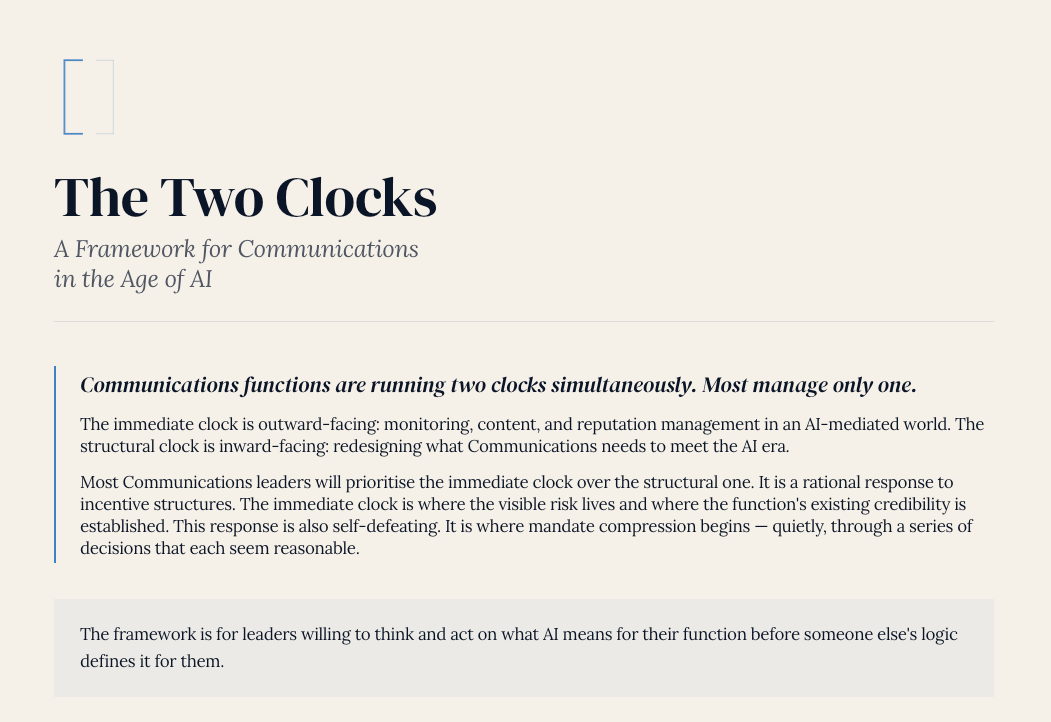
He summarised the logic with characteristic bluntness. If you sell outputs, you are in trouble. Press release distribution and output-based KPIs are exposed. If you sell outcomes, and genuine media relationships built on interpersonal trust with journalists, that is a different proposition: something AI can support but not replace. He would not, he said, sweeten that pill.
One story stuck with me. A freelancer was being hired by agencies to write tone-of-voice guidelines, which the agencies then used to train AI models, before telling her the AI could now do her job. The threat does not stop at the agency; it runs down the food chain. Ben helped her introduce a contract clause preventing her work being used to train AI. A small, practical win, and a reminder that some of the protection here is a drafting problem.
A way in: the Bridges model
For teams that feel behind, Ben offered his BRIDGES model from the book (more about that in this other recent interview). Its value is less in the acronym than in where it tells you to start. The teams getting this right, he said, are not asking "what can we use AI for?" They are asking "what problems or ambitions do we have that AI could help with?"
In practice, BRIDGES means briefing the right leaders first, starting from business problems rather than tools, running two or three bounded experiments, building prompt skill alongside them, agreeing basic team guidance, evaluating quickly, then supporting wider adoption.
The model briefs leadership and IT first, and Ben was firm that comms has to manage upwards here, because too many programmes are led by IT alone. "This is a change programme, not an IT programme." IT can govern the tools, he argued, but it cannot define the reputational judgement, the stakeholder acceptability or the tone of use. That is where communications has to lead.
He warned, too, against teams quietly self-funding licences or running shadow AI, (using AI in ways that are unsanctioned or tools that are prohibited) , which works only until it does not. From there: identify two or three tasks to experiment with, no more, because throwing AI at everything makes the impact impossible to measure. Develop prompt skills alongside. Put a basic team policy in place now rather than waiting for the perfect organisational one, which "is just right for about five seconds before the technology changes anyway".
Bad training creates its own drag. If a team's first AI session is generic, overhyped or irrelevant to their real work, Ben observed, they may be slower to come back when the next round has become genuinely useful. Evaluate honestly with a short huddle after a fortnight, then support the wider organisation.
The most memorable part was a story about shadow AI. When Ben trains a team, he runs an amnesty: get everyone in a room that trusts each other, and ask what they have actually been using AI for. "There hasn't been a session I've done in the last three years," he said, "where the head of comms hasn't gone, 'I did not know you were doing that.'" Sometimes it is faintly alarming. More often it is the opposite: a team realising it is further down the road than it thought.
He added a warning about champions. The person who self-selects as the AI lead may not be the one you would choose. He recalled a college chief executive whose trailblazers were the staff he would rather have kept in the classroom with students. It is an argument, Ben said, for strategic adoption over leaving it to whoever puts a hand up.
What this means for comms leaders
For me, this was the clearest leadership lesson in the conversation. AI adoption does not begin with a tool rollout. It begins with finding out what people are already doing, deciding what is legitimate for the work and the stakeholders involved, and creating enough shared language that experimentation becomes visible rather than hidden. The risk is not only technical. It is reputational, commercial and cultural.
The book that started on a dog walk
AI for Public Relations began, as Ben tells it, on a dog walk. He and co-editor Stephen Waddington were in various WhatsApp groups about AI, and worried that the tone of some was "a bit gung-ho". More seriously, they worried the profession lacked agency over how AI was reshaping it. "I don't want to belong to a club that's rubbish," Ben said. He wanted to gather as many informed voices as possible into one discussion. Waddington's answer was characteristically direct: write a book. If you build it, they will come.
They approached people they knew to be genuine experts and practitioners, among them Andrew Bruce Smith on technology, Richard Bagnall on measurement, Serena Mitchell on in-house adoption, Amy Mollett on AI policy, and Professor Anne Gregory and Dr Swati Virmani on AI's social ramifications. The book is deliberately practical, with key takeaways closing every chapter, and it stays away from forecasting the technology itself. The aim, Ben said, was something "timely, but not time-bound".
On what comes next, he was careful. Anyone forecasting AI's path with certainty, he said, is "either overconfident or telling fibs, or both". But he named trends he is confident about: pressure on early-career roles, changing team shapes, AI skills written into job descriptions, and a societal split in attitudes, with employers markedly more positive about AI's effect on jobs than the people they employ.
For comms specifically, he flagged AI-enabled deepfakes and disinformation as a core defensive skill the profession has to build. The point is not only that comms teams will use AI. They will operate in an AI-mediated information environment, where synthetic content, search summaries, deepfakes and stakeholder suspicion all affect trust. That is the strategic part of the conversation worth keeping in view, even when the immediate work is about tools and policies.
One thing to do differently
I closed by asking what Ben would want a viewer to do differently after watching. His answer was unglamorous, and I think exactly right: learn to instruct an AI well. Even as agentic tools spread, understanding how to explain your workflow and your intent to a model is, in his words, "the singular most impactful thing you can do for yourself".
For comms teams, that means treating AI instruction as a briefing discipline: context, objective, audience, constraints, evidence, tone, review criteria. The skills are not foreign. They are the briefing craft most of us already practise, made explicit and made repeatable.
Ben practises what he preaches in how he stays current. Half a day a week, a Google Alert on artificial intelligence, every relevant story read and filed in a library tool called Raindrop.io. He deliberately does not use AI to summarise any of it. "Otherwise I don't learn anything myself." From one of the most rigorous voices in this field, that felt like just the right place to stop – leaving us with plenty to mull over and put into our own practice.
AI for Public Relations: A How-To Guide for Implementation and Management, co-edited by Ben Verinder and Stephen Waddington, is published by Kogan Page and available now. If you want the depth behind this conversation, start there. You can connect with Ben on LinkedIn.
Putting it into practice, live this Friday! Ben's point about learning to instruct AI well is exactly what we will be doing in the open. On Friday 5 June, 13:00 to 14:00 BST, I am joining Emma Ewing of Big Fish Training for a free lunch-and-learn. We will take a vague, slightly chaotic comms brief and build it into a clear, structured campaign pack, live on screen, using a repeatable workflow in Claude (Projects and Skills). You can shape the session as it runs by suggesting audiences, objectives or curveballs of your own, with time for questions throughout. The focus is not on perfect outputs but on understanding where AI fits in real comms work, and where human judgement and quality control still matter. Register here.