Comms With AI: How I Built an Award-Winning AI Communications Tool in 3 Months (and What I Got Wrong)
Three months ago I documented building Comms With AI with Claude Code. On 18 June it won Gold at the inaugural AI Comms Awards, and I was named AI Communications Leader of the Year.

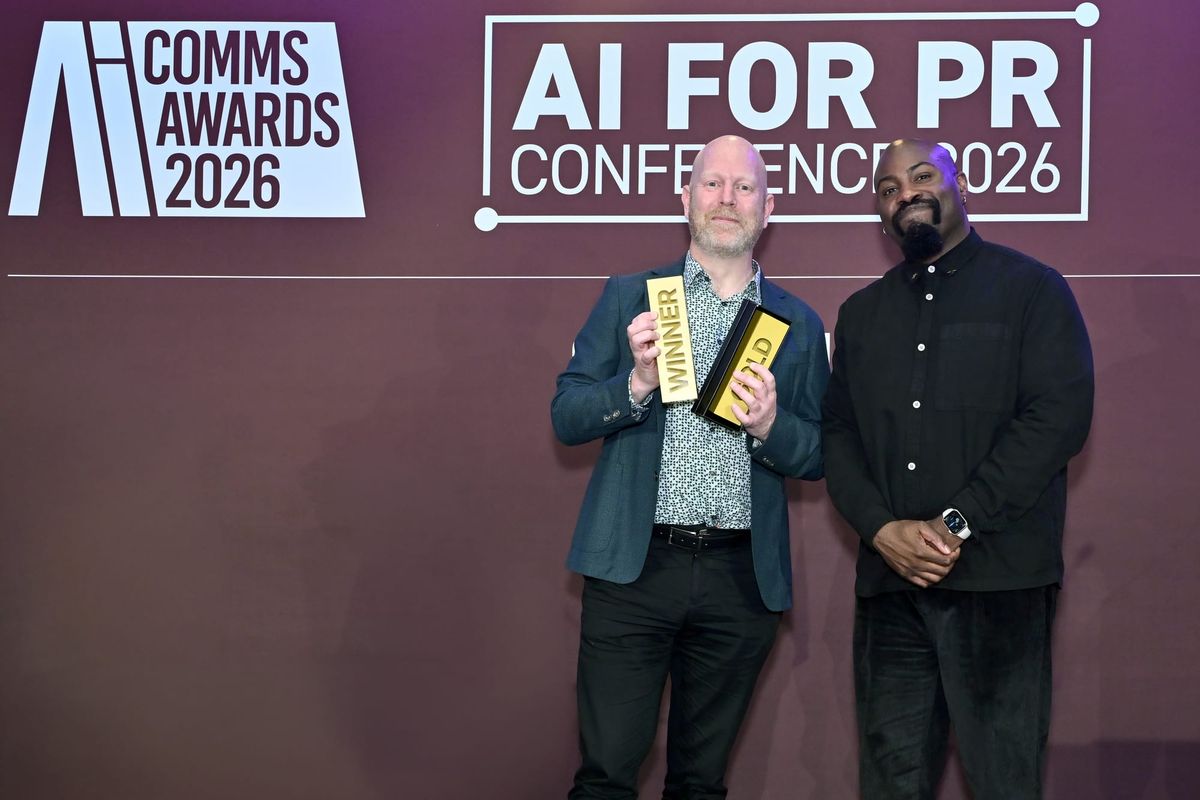
Three months ago I documented building Comms With AI with Claude Code. On 18 June it won Gold at the inaugural AI Comms Awards, and I was named AI Communications Leader of the Year. In between, and more quietly, it rebuilt itself from a template library into something closer to a product. Here is why I built it, what the rebuild taught me, and the calls I would make differently.
In March (which now feels several lifetimes ago), I wrote up how Comms With AI got built: roughly ten hours of Claude Code to a functional site, then two months of structured iteration to make it worth using. That piece ended on an open question. If the tools have made building this easy, what is the actual moat? My answer then was the professional judgement embedded in the content, and I said I would come back to it once the site had been in real use.
Fast forward to Thursday evening, and at the inaugural AI Comms Awards on 18 June – run by the excellent Communicate Magazine – we won Gold for Best Innovation in AI Tools for Communications, while I was named AI Communications Leader of the Year for the work behind it.
The judges' citation described the platform as "simple, specific and scalable", and one judge called it "an innovative tool grounded in strong communications use cases and delivering real results". As you'd imagine, I was blown away by the results – and keen to make the most of this result to further what I've been working on and sharing with others.
However, before anything else, I want to be upfront about what that does and does not mean, because practical honest is at the core of the Applied house style. An award does not validate the content. Only sustained real-world use can do that. What it does tell me is that a resource launched in weeks, then sculpted over a few months, by someone who is not a developer, can now stand next to established industry work and not look out of place. Eighteen months ago that sentence would have been a stretch.
That is a more interesting story than any bloated self-congratulatory puff piece, and so here I'll aim to delve into the what, why, and how of this – as well as what lies ahead. (While admittedly still patting myself on the back a wee bit...)
What Comms With AI is – and why I thought this needed to exist
Let's start with the why, since I skated over this in March, and it is the part that actually explains the rest.
Applied / Comms With AI began life last summer as a newsletter, written while I was working through Imperial College's Professional Certificate in Machine Learning and Artificial Intelligence. The frustration that started it was simple. A bulk of what was espoused about AI for communicators was either breathless evangelism or vendor marketing dressed up as insight. What was largely missing was honest, practical guidance from people who actually understand the work.
CommsWith.AI (as it was initially styled, thanks to a random domain purchase alongside the appliedcomms.ai get) grew straight out of that. The need I was building for was not "more AI content". It was a place where a comms professional could find something tested, specific to their job, and usable inside 5-10 minutes, without wading through hype to get to it.
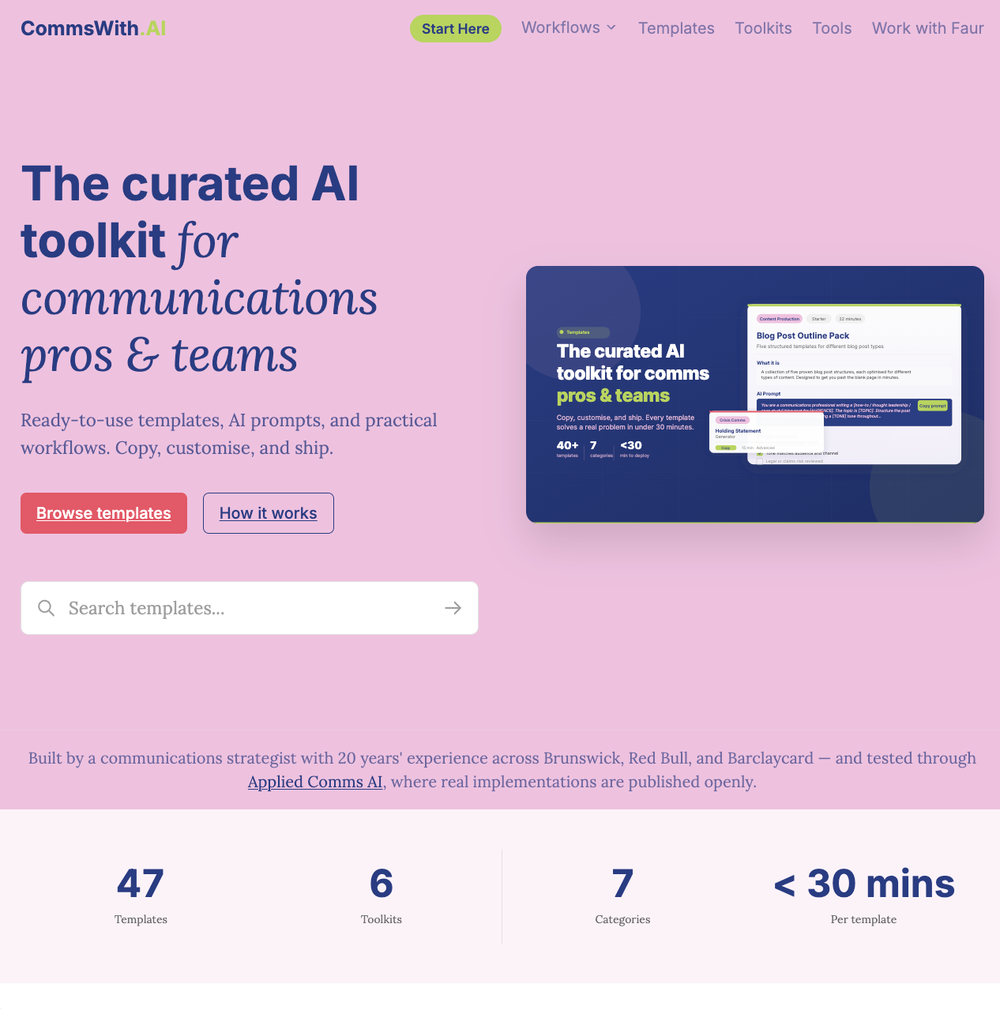
Therefore, the first version of CWAI was deliberately concrete: 47 templates across seven workflow categories and six toolkits. The intent was utility. Take a prompt, get on with your day.
That intent was right, which is more than can be said about the organisation...
What I missed at the beginning
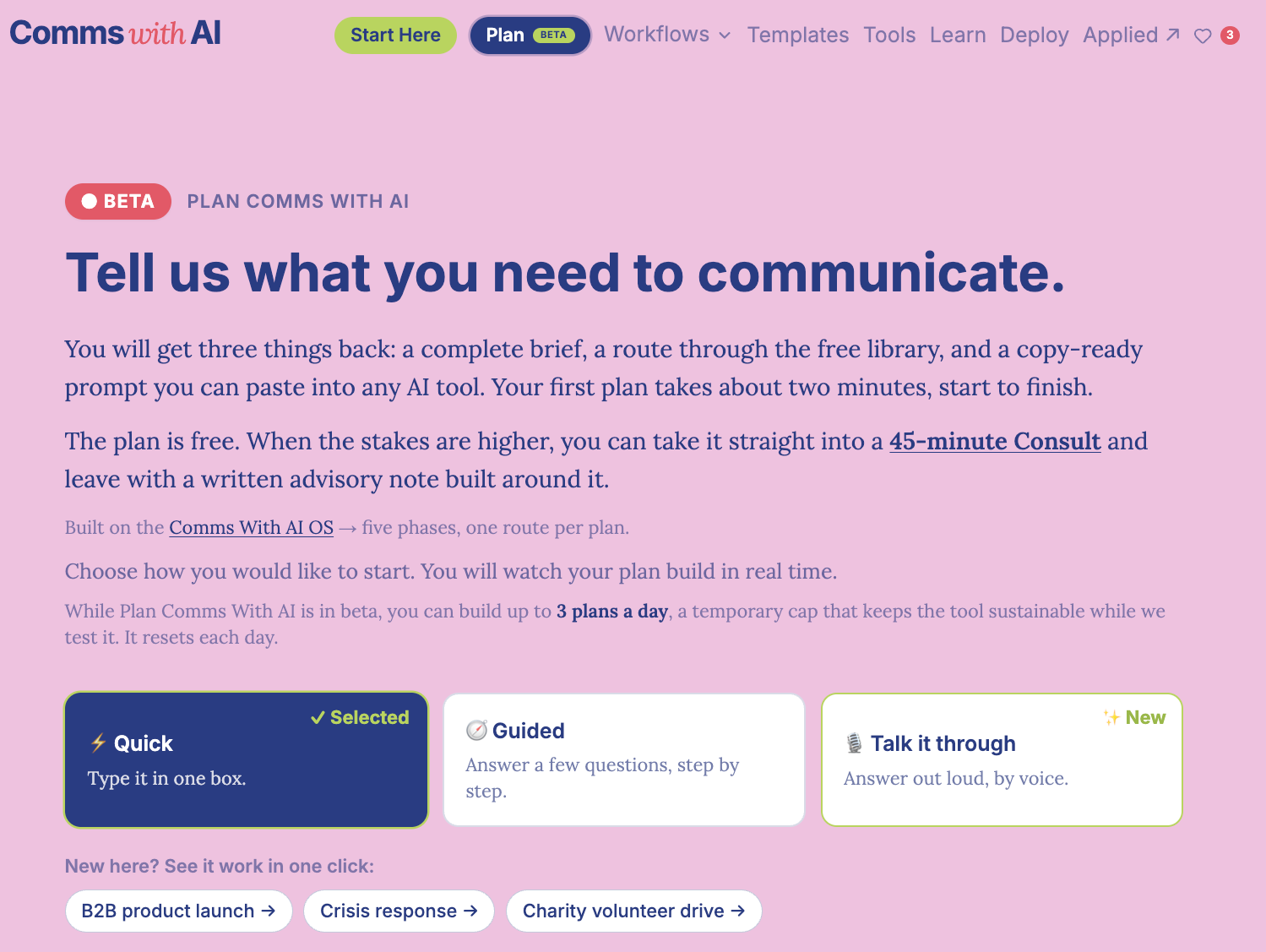
The library now carries 62 templates, seven toolkits and a directory of 44 tool reviews, with new bundles such as the Crisis Preparedness and Campaign Measurement toolkits, and a five-minute readiness diagnostic that scores a comms function across six dimensions and points the visitor to a sensible starting point rather than a wall of templates. Crucially, we now have a functional beta of Plan Comms With AI, directly using AI to provide an additional layer of support.
Three months later, 5-10 hours per week of dedicated work. The rate of change surprised me, and I often balanced the exhiliration of this against the frustrations of still spending more hours than it felt worth struggling with setups in time-honoured tools such as Mailchimp and Canva (the more things change etc etc).
The resource count is not the headline change: it's that the seven flat categories are gone, replaced by a five-phase operating system: Strategise, Create, Govern, Monitor, Transform.
If those five sound familiar, they should. They are the spine of the AI Agent Series I have been publishing this spring, named explicitly when the series set out its framework in April: the cycle that runs from the work before the work, through creation and governance, into monitoring, and finally into building the capability to do it better next time.
Regrets, I've had a few...
One thing I would have done differently: the model was sitting in my own published thinking the whole time, and I still shipped seven sensible-looking categories instead. A flat taxonomy is fine at 47 items. At 62, with a clear path to many more, it fragmented: categories overlap[ed, a visitor cannot tell where a new template liveed, and the thing stopped feeling like a system and started feeling like an unruly pile.
The phase model fixes that at the root. Every template has one obvious home, every toolkit maps to a stretch of the cycle, and the structure does work that no amount of individual template quality can do on its own. I watched the categories strain as the library grew, then spent real effort retrofitting an operating system onto content filed against the wrong logic. The lesson is the one I would press hardest on anyone doing this: decide the fundamental structure before you scale, because retrofitting it later is the most avoidable work there is.
From handy resource to award-winning product
The other shift is harder to see in a screenshot. CWAI started as a handy resource, a place to grab a template and go. Three months on it behaves like a product. The diagnostic routes you. The operating system organises you. A new front door, Plan Comms With AI, now in open beta, turns a plain description of what you need to communicate into a brief, a route through the library, and a copy-ready prompt.
Around the free library there is now a set of paid options for the work the templates cannot do on your behalf: a consultation booking option, training delivered alongside the wonderful Big Fish Training, and a Deploy service for governed AI rollout inside an organisation.
The publication arm has folded in alongside all of this. Applied is no longer a sister project running in parallel; it is the learning lab that feeds the platform, now including a live interview series. The first, The Honesty Gap with Ben Verinder on AI, PR and trust, set the format. The next, Elif Güvençer on her Two Clocks framework, runs on 1 July. And the first vertical, Leader Comms With AI, built for senior comms leaders rolling out AI across their teams, opens later this week with a free Leadership AI Governance Toolkit.
One principle set at launch held under all that pressure, and I have absolutely zero plans to ever change this. The library is free and stays free. No gate, no account, no email wall on a single template. The paid layers exist for the organisation-specific work, the readiness, the governance, the redesign, that a generic template was never going to solve. Templates make the repeatable parts repeatable, and the hard, contextual work is done with people.
It is the moat question from March, answered slightly differently. Defensibility was never going to be the templates, which anyone can now generate. It is the judgement about how they fit together, what good looks like, and what a given team should do next. The structure and the services are both expressions of that judgement, and I think that is what the award was actually recognising.
What I got wrong, and what I have not proven
Four things:
- The structure call is the big one, and I have already made it, so I will keep it short: build the operating model before you scale, not after. What I would add now is why it matters beyond tidiness. comms people are not short of tools to read about. They are short of time. The reader I am building for is not someone with an afternoon to delve into every template; it is someone stretched thin, between deadlines, who needs to reach the one relevant thing quickly. Structure is what makes that possible. A coherent model is not housekeeping. It is the whole point.
- The second is scope. When building is this cheap, the temptation is to keep adding, and "more templates" feels like progress because it is measurable. It mostly is not. A few of the things I added early earned their place. A few were there because I could, and they diluted rather than strengthened. The discipline that matters now is subtraction – or at least maintaining a considered balance – and it is harder than building, because nothing prompts you to do it.
- The third I cannot resolve yet. I still do not have a confident read on how the resource performs in genuine, sustained use, as opposed to first visits and kind words. That was the open question in March, and the award does not close it. Usage data is starting to accumulate, and I will report it further when there is a scope of time which says something real rather than something flattering. The honest position three months in is that the build is proven and the value in the wild is not, quite, yet.
- Finally, something which deserves its own section...
The part that needs people
There is one more lesson, and it came from outside the glare of the screen.
At the AI for PR Conference, which sold out with almost 400 attendees and is already confirmed to return in 2027, the questions that stayed with me after were not about prompts or tools. They were about roles. Practitioners asking, in different ways, how their work with clients changes when the client can do more of it themselves. It was a consistently aired and fair worry: from my own experience, I think that as in-house teams take on more of the doing, the agency relationship moves further towards advice and consulting. That is exactly where most of our experience actually lives, and it is increasingly what I am building the platform around.
Training is part of the same realisation. I barely thought about it at the start, and it is now becoming central. Handing someone a good prompt is useful, but it does not replace a proper conversation, whether that is between a comms agency and its client, or me running a hands-on session, or one of the Leader webinars. Building those human layers back into what started as a pure resource bank has been the most rewarding part of the last three months, and the least expected.
What this means if you are building too
The practical takeaway is not the toolchain, which will be different by the autumn. It is that as the tools get easier, the fundamentals get more decisive, not less. A coherent model of the work beats a fast accumulation of parts. Knowing what not to build beats knowing how to build it. And the questions worth asking before any of it are not "what can I make?" but "what should this be, who is it really for, and how should it be organised so it still makes sense at ten times the size?"
The two awards are a welcome marker, and I will not pretend otherwise – not least since they'll be appearing in the background of any Zoom call from today onwards... However, the rebuild around a stronger structure is for me the key lesson. It's what I primarily got wrong when first launching, and I am keen to see how things now perform with this in place. I will take both into the next period of CWAI and report back, as ever, on what works and what does not.
Where we go next
The library stays free, and the next three months are about adding the human layers around it.
On 1 July, the interview series continues with Elif Güvençer on her Two Clocks framework, a conversation about repositioning comms for the AI era. It is free to join, and shall be a fascinating chat.
And on 7 and 8 July, I am running two hands-on AI training sessions for comms teams with Big Fish Training: one for account executives, one for account managers and directors. These are the proper conversations the templates were never meant to replace!
And last but certainly not least, this week the first vertical goes live: Leader Comms With AI, built for senior comms leaders rolling out AI across their teams. It opens with a free Leadership AI Governance Toolkit, the part most teams are missing.
If any of that is useful, come and join in. This is what Comms With AI is all for.
Applied / Comms With AI documents what actually works in AI implementation for communications professionals, including what does not. Explore the resource at CommsWith.AI, and subscribe at appliedcomms.ai.