The living fact layer and the death of the PDF: NOAN CEO Neal Mann on why most AI-powered communications is built on sand
NOAN CEO Neal Mann explains the idea of a living fact layer, why hallucinations are structural rather than accidental, and what communications leaders need to rethink before AI can deliver real value.

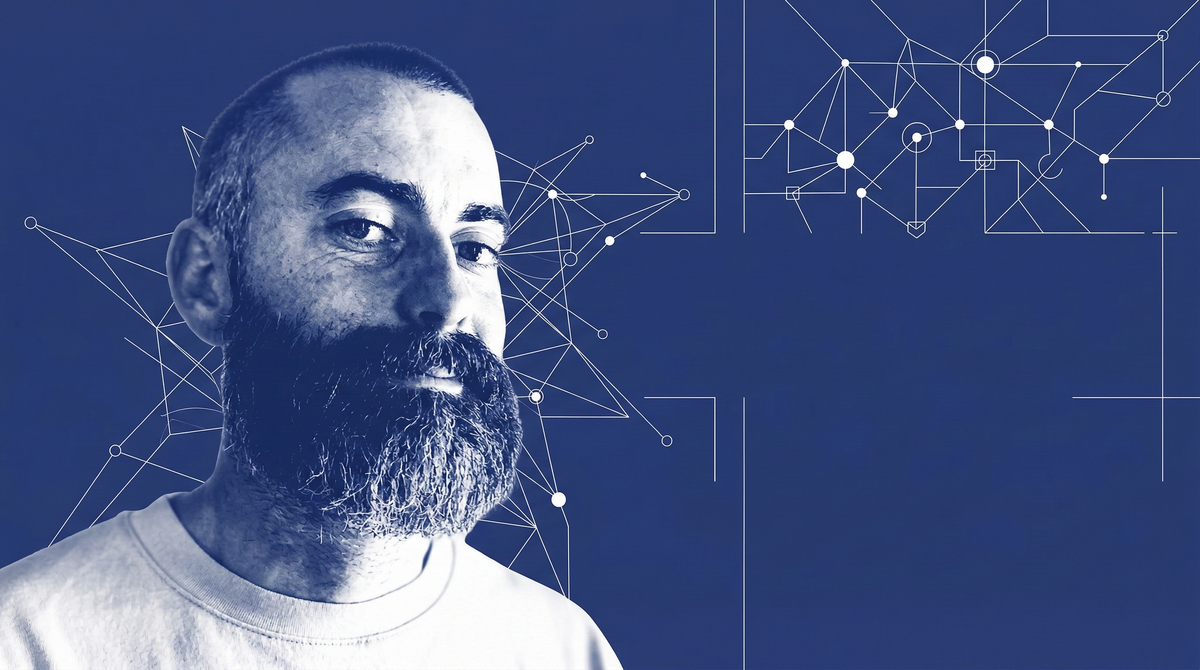
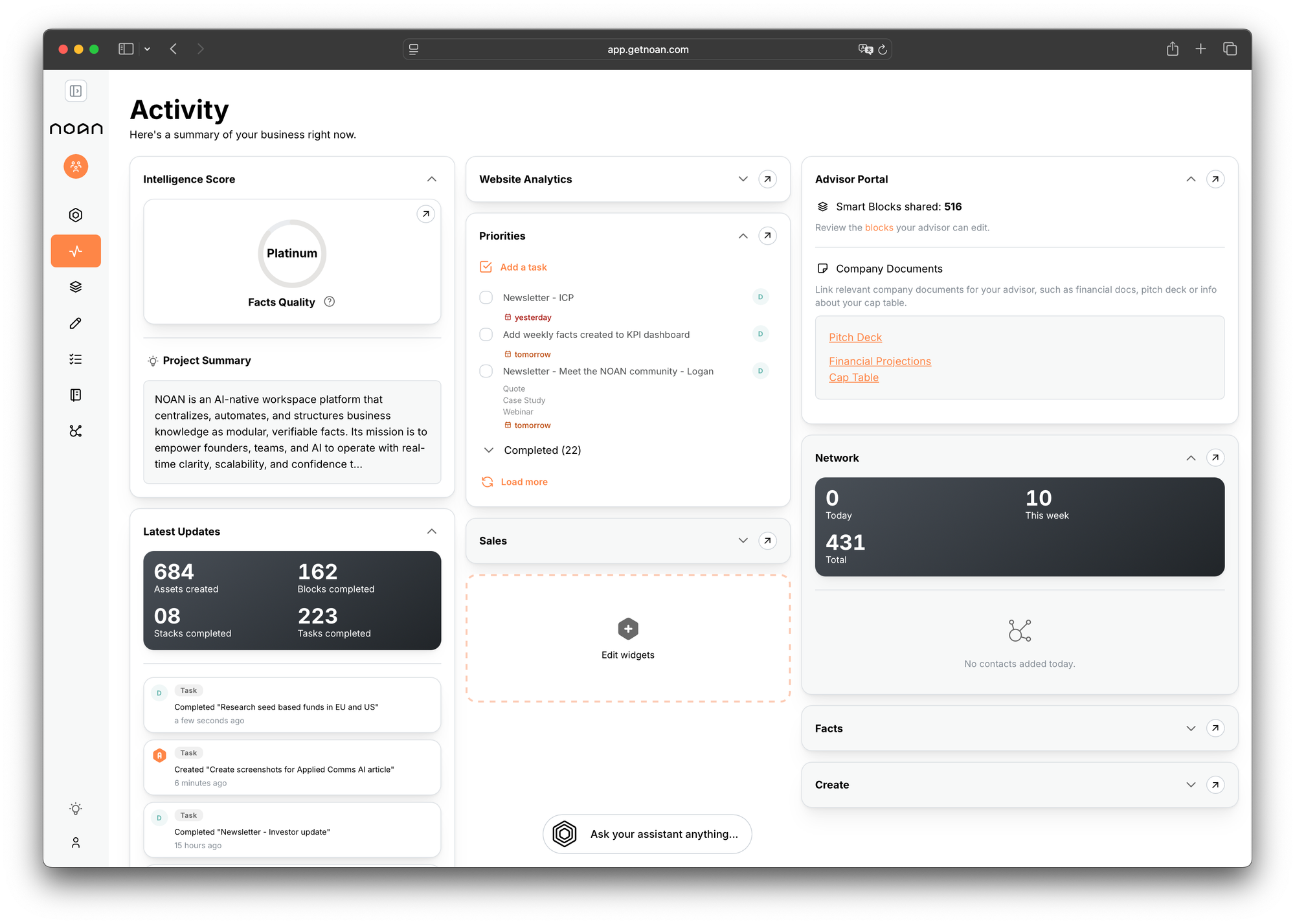
Neal Mann is CEO and co-founder of NOAN – an AI-native platform built on a simple but radical premise: that most businesses are running on fiction. Not lies, exactly, but something nearly as bad – documents nobody updates, strategies stored in PDFs nobody can find, brand guidelines that exist in seventeen slightly different versions across a shared drive. NOAN replaces all of that with what Mann calls a living fact layer: a single, structured, always-current source of truth that both humans and AI can work from simultaneously. Change one fact, and it propagates instantly to every agent, every team member, every workflow that depends on it. It's an argument about knowledge architecture as much as AI – and for communications professionals, it has some fairly direct implications for how they work.
I used NOAN to prepare for this interview. Here's what that taught me.
Ten minutes before this interview, I opened NOAN and asked it to generate interview questions.
I should say: I'd already had a quick introductory call with Neal the week before. I knew the conversation would flow. Neal is direct, opinionated, and clearly comfortable talking about what he's building – so there was a reasonable floor regardless of how prepared I was. But I was curious what NOAN would produce with a minimal brief, so I signed up that morning, dropped in a short note about the article, and let it run.
What came back was competent: well-structured, professionally framed, a solid general set of questions for an AI in communications interview. You can read them [here on Applied Comms AI]. Probably useful as a starting point.
What it didn't produce was anything specific to Neal – no thread back to his journalism background, no engagement with the article he'd published two days earlier, nothing drawing on our first conversation. That's entirely on me. I gave it ten minutes and a thin brief. The platform is built on the principle that accurate AI requires accurate inputs – feed it a vague prompt and it returns a general answer. I'd done exactly what Neal would diagnose as the fundamental problem: asked an AI to work without a proper fact layer behind it.
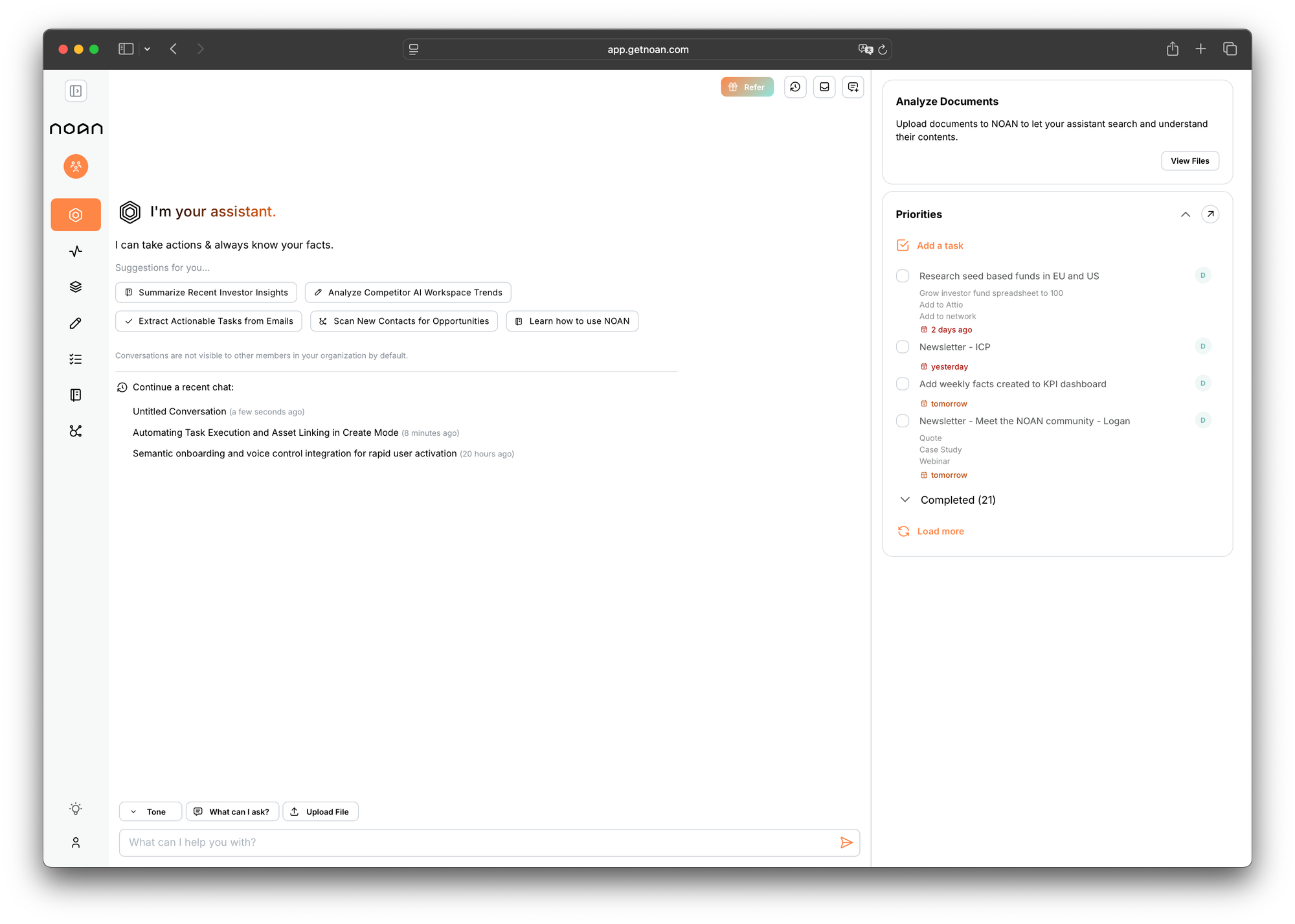
If I'd invested the time upfront – fed it the transcript from our first call, his LinkedIn, the NOAN website, a clear brief on what Applied Comms AI readers need from an interview – the output would have been materially better. That's the test I should have run, and the lesson is straightforward: AI repays preparation. The more context you give it, the more it gives back. Skipping that step doesn't save time; it just shifts the effort downstream, into the gap between what the AI produced and what you actually needed.
I mention all this upfront because it's the most honest way into the conversation that followed. Neal Mann has spent his career arguing that AI fails not because the models are bad, but because the knowledge behind them is a mess. My rushed NOAN session was a small, live demonstration of exactly that.
The man who really hates PDFs
Neal Mann is co-founder and CEO of NOAN, based just outside Lisbon with two young children, two technical co-founders, and what sounds like a genuinely relentless pace of work. Before the interview began, he mentioned he'd been on calls since 7am.
His career path is an unusual one for a startup founder. He started in broadcast journalism at Sky News, moved to editorial innovation at the Wall Street Journal, was part of the team leading the migration to subscription at News Corp in Australia under the CTO, then spent nearly a decade as a transformation consultant at Anomaly – working with the C-suites of companies including Microsoft, Google, NBC Universal, and Expedia on how to rethink how businesses actually operate.
A former client recently reminded him of something. Nearly ten years ago, in a consulting presentation, he'd put a PDF on a slide with a large red X through it.
"What company runs on these?" he remembers asking. The answer, it turned out, was: all of them. And it still drives him slightly mad.
"The A4 format was essentially designed in the 1700s to share information accurately – PDFs are just digital versions of that," he says. "People are still using it to build AI-native companies. No versioning, no audit trail, no history. It's actually quite funny when you see someone say they're building an AI-native business and then tell you they're referencing their documents."
He published an article just before we spoke – Your Company Is a Burning Mess of Documents – Here's Why We Built Ours as an API – which captures the argument without softening it. The PDF, the strategy deck, the shared drive that nobody can navigate: these aren't just inconveniences. In the AI era, they're structural liabilities. And most organisations haven't reckoned with that yet.
From Sky News to the knowledge problem
NOAN's founding logic runs directly through Neal's consulting years. Drop into a global company, spend three months on discovery, and you'd find the same thing every time: teams operating on different versions of reality, decisions made on stale information, strategies that existed in decks and went nowhere after.
"A Fortune 100 chairman once told me he didn't understand why his sales teams were still using five-year-old materials," he says. "When you're in the weeds, you start to understand why. Everyone is operating in a silo, in their own skill set, their own bubble. Someone's been doing something a certain way for fifteen years because Dave, fifteen years ago, decided that's how it would be done."
The News Corp years in Australia were where the thinking crystallised. Working under the CTO on migrating a hundred brands to shared subscription infrastructure, he was dealing with exactly the problem NOAN was later built to solve: how do you get disconnected teams working from one source of truth? He saw the same dynamics at every major client after that – and when AI arrived, he saw the problem about to get dramatically worse.
"If you do not solve the knowledge problem before you add AI, it gets exponentially worse. You just cannot put AI on top of a mess of business knowledge and expect accurate results. These are knowledge referencing and prediction machines. The knowledge has to be right."
Hallucinations are structural, not accidental
This is the core argument of NOAN, and it's one that Neal makes precisely.
"Hallucinations are not a bug. They're a feature of how LLMs work. If the inputs are bad, disconnected, or contradictory, the outputs will be bad." He illustrates it with an analogy that's stayed with me since. "Working with NOAN is like walking into a street and seeing one person. You ask where the pub is. They say it's two streets down on the left. You go. Done. Working with AI against a typical enterprise knowledge base is like walking into a street with 250 people and asking the same question. You get 250 different answers. The AI never knows which one is true, because there's no single source of truth."
The problem isn't that AI models aren't good enough. It's that organisations haven't built the conditions for them to succeed. Most companies have 25 versions of their brand positioning. Multiple documents contradicting each other on pricing. Strategies that live in one deck, product roadmaps in another, sales messaging in a third. "People find it cathartic when they join NOAN," he says, "because they go, 'God, I've got 25 versions of that, and I actually need one.'"
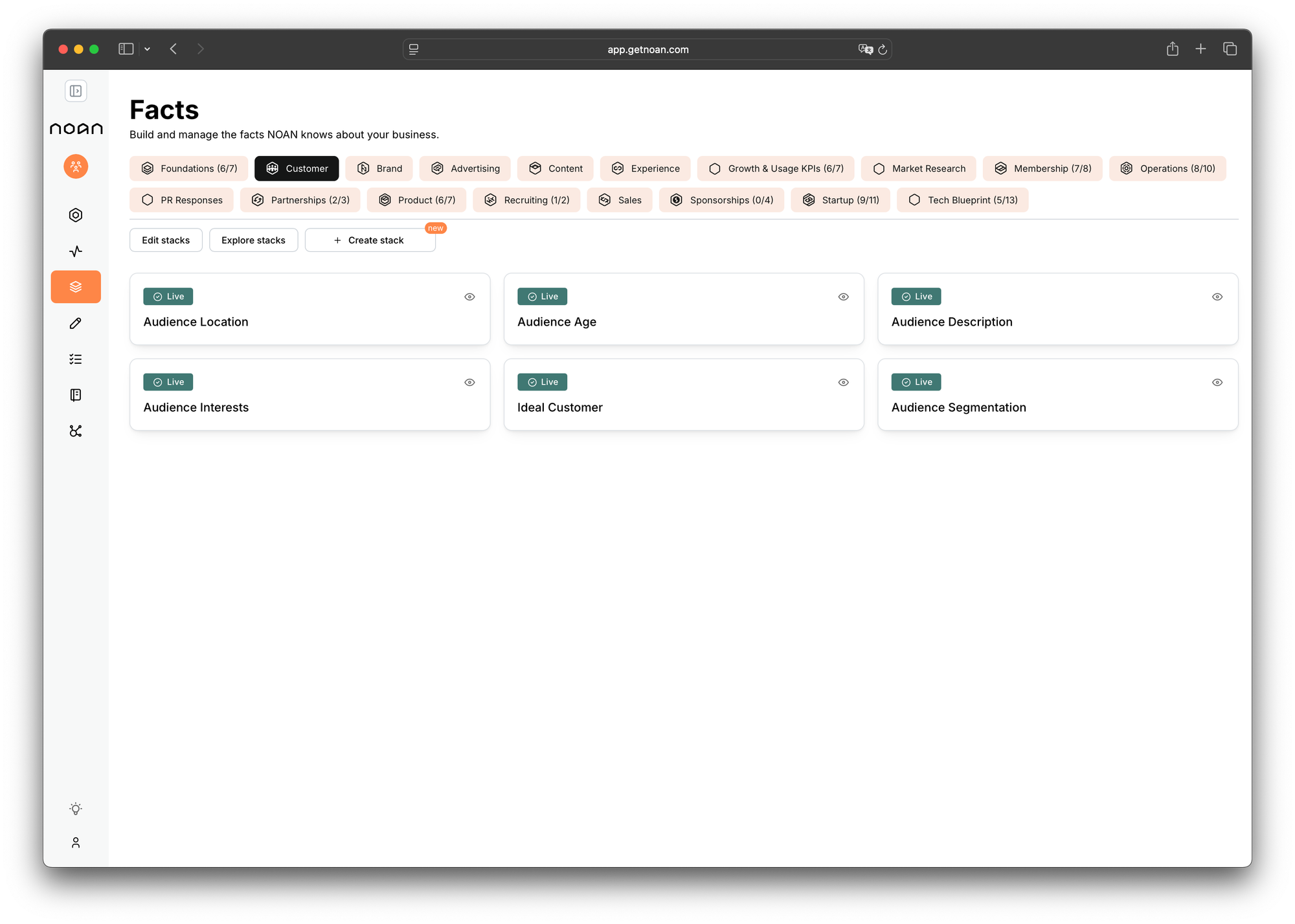
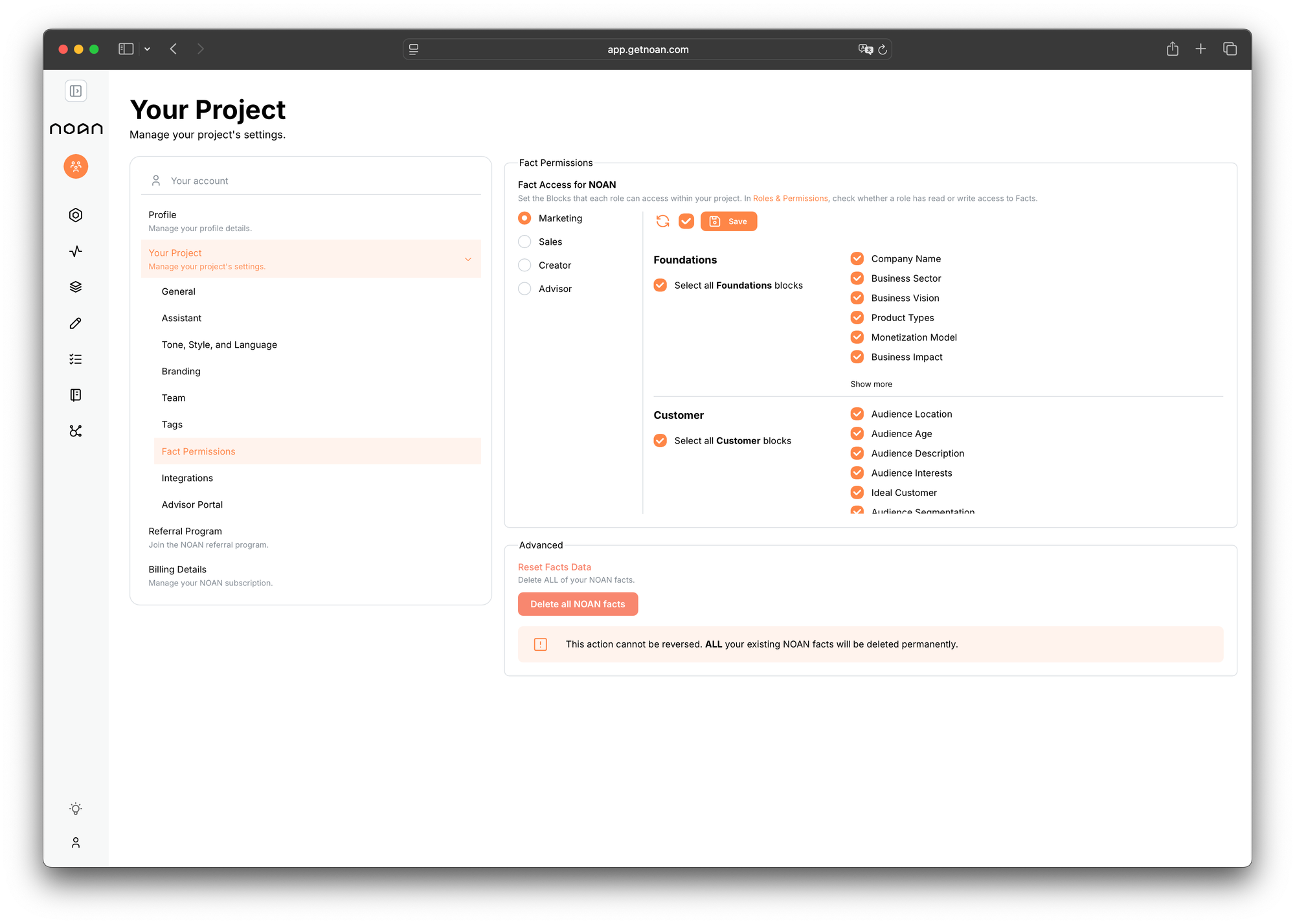
NOAN's solution is to replace documents with facts – structured, auditable, live pieces of business knowledge that update once and propagate instantly to every agent, every team member, every workflow that depends on them. Change your positioning, tell the assistant, verify the proposed fact update, and it's live everywhere simultaneously. "That's fact control," he says. "It's not a Slack message you hope Dave in the CRM department eventually reads."
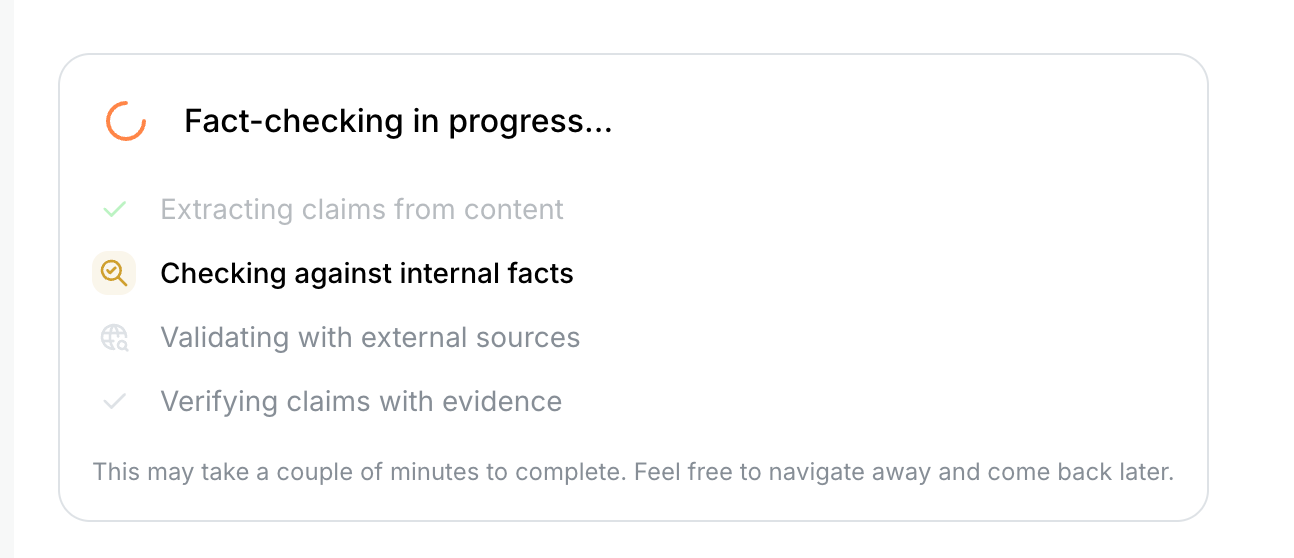
He recently shipped a fact-checker in beta: create something through NOAN, and it analyses every claim, weights its accuracy, flags potential issues, and verifies sources. The platform is moving fast – since our interview I've been in the NOAN user community, and the pace of new features being released is striking. The team are clearly building at speed, which feels appropriate for a product designed for exactly the moment AI itself is accelerating most rapidly.
"Brief it like a person"
One of the sharpest things Neal says about where AI products are heading is about the end of prompting.
"About 90% of our users are using voice control. NOAN is built for natural language. You don't need to prompt it like you do with ChatGPT or Claude. You're just talking to it."
The prompt engineering era, as he sees it, treated users as technicians when it should have treated them as managers. "When people come from ChatGPT, they immediately engage in a way the product isn't built for. They'll drop in and start giving it a long prompt about who it is and what it's got to do. There's no need. The product has taken that away. It knows what it's executing. It's listening for what you're looking for."
The mental model he gives new users: imagine you're walking over to the world's best employee – someone who knows all the live facts of your company at any time, has hundreds of tools at their disposal, and can execute clearly. "Brief it like a person. This is what I want. This is what I need. Execute it." He pauses. "You'd never say to a colleague, 'Hello, how are you, I've been thinking about this, what do you reckon?' You just tell them what you need."
This isn't niche. "You're going to see more and more products designed to be instructed like a human, not like a prompt pack. Prompt engineering is starting to seem quite archaic."
Who NOAN is for – and what that says about the industry
NOAN is not trying to solve the enterprise problem. At least not yet. Neal is clear about this, and his reasoning is worth sitting with.
"We started and will always design for one person running a global company. Everything is built around that – how one person could run it – and you add team permissions on top."
The logic is partly practical. Large enterprises are too structurally broken to retrofit. "You'll always be papering over the crack. Band aid over an arterial bleed." But the more interesting observation is forward-looking: he doesn't think those enterprises are the future anyway. "Block laid off half its staff yesterday. In twenty years, how many enterprise companies will be the size they are now? An enterprise company with agents deployed is going to be three or four people running from a single fact layer."
This lands differently against a piece I'd been reading in the Financial Times just before we spoke, about consultants leaving the big firms – PwC, McKinsey, Deloitte – to start their own AI-native businesses. The FT piece frames it as a talent drain. Neal would frame it as an inevitability. The solopreneur or small founder can start again from first principles. The incumbent is still fighting its own document problem. "It's so much easier for a solopreneur to burn it down and go, 'this is the moment, this is the time.'"
His own ICP, he acknowledges with some amusement, turns out to be himself: a non-technical co-founder running marketing, sales, and investor relations on the platform he's building. "Our underlying mission is that AI can be a force for good in the economy when put in the hands of people who couldn't do things before. Small businesses couldn't afford content marketing. They're struggling with sales without a dedicated hire. If we give them the tools to automate and scale, they can actually grow rather than die."
The FT article focuses on consulting. The communications industry has the same dynamics – holding groups under margin pressure, independent consultancies moving faster, in-house teams caught in the middle. The question of whether the pace of AI-native startups like NOAN will drive more radical restructuring of the comms sector feels live. There's a reasonable argument that the agility advantage accruing to smaller, AI-native operators isn't temporary friction – it's a structural shift in who can do what, and how fast.
What the media gets wrong
Neal has journalism in his bones, and strong views about the AI coverage.
"Most journalists, including those who cover business, have never run a business. I would put myself in that camp when I was at the Wall Street Journal." His former colleagues there have reached out acknowledging the same. The coverage fails in two directions simultaneously: it amplifies the AGI narrative on one end – the utopia or existential risk framing – and credulously reports enterprise AI announcements on the other.
"You see a lot of nonsense from enterprise companies about how they're deploying agents to do X, Y, Z. If you know people at those companies, or you've worked there, you know they couldn't implement BI, let alone AI. They spin it, journalists take it and spin it further, and you get a fear narrative around job losses when those organisations are simply not structured to implement this technology yet."
On AGI specifically: "Gary Marcus, Yann LeCun – legends in the field – have said we're not getting to AGI this way. When you actually work with AI, you realise it's not happening. You can't get it to say the same thing twice. It's not built that way. These are knowledge referencing and prediction machines. If people understood that – really understood it – they'd have a much better sense of how to actually use them."
The stories that aren't getting told are the smaller ones. "We've got farmers running NOAN doing things they couldn't do before. Lawyers. All kinds of people across different sectors. The coverage is so focused on the top tier that what smaller businesses are actually doing with this technology is almost invisible."
What building a product on your own product teaches you
My closing question produced Neal's longest answer, and the most honest one.
Building NOAN on NOAN has forced first principles thinking into every decision. He gives the example of tagging. "Most platforms add manual tagging – you add the tag. I wrote a GitHub ticket to add tagging to an asset. My technical co-founder said, 'why don't we just run the context through an approach that automatically looks at the semantics and tags it.' Of course. That's how it should work." That reflex – what are we actually trying to achieve, and what's the most direct AI-native way to achieve it – runs through the entire product.
There's also something more structural about building voice-first that he found genuinely novel. "You have to think through how you name every feature. The name has to be natural for a human to say, and it has to match precisely what the AI is coded to do. We've never had to do that before, ever. The way you architect a feature's name determines whether the AI puts things in the right place."
But what he keeps coming back to is community. "So much of AI takes away the personal aspect. You realise that a lot of the business – because products can be replicated pretty quickly – is going to rely on being part of something, feeling part of a brand." He mentions power users in the NOAN WhatsApp group doing things he hadn't anticipated. "Someone will do something and you go, wow, I didn't know it could do that. Building this has taught me how close you have to be to your customer – and you're even closer if you use your own product every day."
He's unsentimental about companies that don't. "There are thousands of companies selling a product they don't use. In this world, if you're building and you're not using it, you're going to fail."
Oh, and that article he published just before we spoke – the one about documents being a burning mess? He wrote it in about ten minutes using the NOAN assistant. Didn't write a word of it himself.
Which is either the best or the worst advertisement for the product, depending on how you look at it. I'd say it's the best.
What communications leaders need to understand
Neal's closing argument is one that cuts directly to the ACAI audience.
"For the first time ever, the immediate use case for this technology is in your sector. If you look at cloud technology – a huge driver of change – the immediate use case was not in comms or marketing. It was in engineering and product. This technology is different. The immediate use cases are in comms and marketing, because at their core, these are content creation machines. That gives you an opportunity to actually be in the driving seat."
But the opportunity is only available to those willing to rethink rather than just accelerate.
"A lot of leaders in the comms and marketing space think they can just make their traditional processes a bit faster. What they need to actually do is go back to first principles. What is our process for doing X currently? What could it be if we integrated AI properly? And then rebuild your entire process around that answer. It's the organisational change that's needed. That's what we've done at NOAN. We've actually just rebuilt what a company is."
His final point is the one I keep thinking about. "In the past, you'd noodle on a deck with C-suite for days. One word on a slide might take two hours to agree on. If you were lucky, it made it to the real world. Today, what you're doing is locking in the semantics of how you want something to come to life. Because of the nature of LLMs, they can execute on those semantics for the first time. And if you come from a world of understanding language and how to communicate – really understanding it – you are in an incredibly powerful place. I don't think many people in those sectors know that yet. But they should be in the driving seat."
- Neal Mann is CEO and co-founder of NOAN. The platform is at getnoan.com. His article on building a company as an API – written entirely using NOAN – is worth reading alongside this conversation.
- If this conversation raised questions about how your team manages knowledge, messaging consistency, or AI governance, the CommsWith.AI template library has practical starting points – including templates for message architecture, approval workflows, and content governance. For bespoke implementation support, get in touch with Faur.
Next up: AI Agents for Comms Leaders – masterclass webinar series

A six-part Applied Comms AI masterclass series on building agent-based workflows for communications teams – from planning and production through to governance, monitoring, and organisational change.
View sessions and register, with a limited-time 50% intro session discount: https://www.appliedcomms.ai/events/
Work With Faur / Applied Comms AI
Applied Comms AI helps communications teams move from AI experimentation to operational value. Through Faur, we offer workflow audits, implementation consulting, and capability-building workshops—grounded in the same hands-on approach you see in this content. If you're exploring how AI could transform your communications practice, drop us a line at info@faur.site or book a consultation session.