The SEO-PR Strategist Who Saw AI Search Coming – And Built a Business to Help Teams Catch Up
Rik Turner spent 15 years helping brands win at search. Then Google AI Overviews changed the rules. In this Applied Comms AI interview, he explains why PR teams are now central to how brands are represented in AI-generated search results — and shares a practical framework for responding.

Rik Turner spent 15 years helping brands win at search. Then Google AI Overviews arrived, and everything changed. His response was to launch PR for AI – an independent consultancy providing SEO & GEO training for PR teams – and to start telling comms professionals something they didn't want to hear, but quickly realised they needed to know.
There's a particular kind of clarity that comes from watching your clients lose traffic in real time.
For Rik Turner, that moment arrived in early 2025. He'd seen AI search coming – ChatGPT's launch had registered as a signal worth watching – but the real inflection point was watching Google AI Overviews roll out and start eating into his clients' organic traffic. First 10%, then 20%, then more. Month on month. Year on year.
"People don't need to go to your website anymore," he says. "They can get all the information they need from AI. And so I realised: this isn't just a new feature. It's actually going to change the whole model."
That realisation – equal parts clarity and alarm – led Rik to launch PR for AI, a consultancy that helps PR agencies and in-house teams understand how their brands are represented in AI-generated search results, and what they can do about it. His thesis is direct, and a little counterintuitive: PR professionals are already the people best placed to shape AI outputs. Most of them just don't know it yet.
From SEO to AI Search: A Natural Evolution
Rik's background is worth understanding, because it shapes everything about his approach. He's been working in SEO since 2010 – not only as a technical specialist, but as someone who always believed the biggest lever in search was great PR and communications work. "I always said: if you want link building, what you actually want is a PR agency," he explains. "Not an SEO agency doing link acquisition."
That conviction – that comms professionals are the natural owners of search visibility – meant he spent years working at the intersection of SEO, content strategy and PR teams, including time at M&S, giffgaff, Waitrose, and Dragonfly AI. His client briefs were rarely about rankings for their own sake. They were about commercial impact: revenue, conversions, business outcomes. That grounding in what visibility actually means for a business is what makes his AI search work distinctive.
When several PR agency founders started contacting him in early 2025 – their clients were asking about AI results, and they didn't know what to say – it confirmed what Rik had been thinking. He formalised his focus, launched PR for AI, and started building a framework for working with teams in this new landscape.
Why PR Teams Are More Important Than They Think
The argument Rik makes to comms professionals is both reassuring and challenging. Reassuring, because it tells them the fundamentals of their craft – building relationships, earning coverage, creating content that resonates – are more valuable than ever. Challenging, because it asks them to think differently about what that coverage is actually doing.
"AI models are pattern-matching," he says. "If they regularly see the problem you solve alongside your brand name or your spokesperson's name, that's going to influence what they say about you when someone asks."
The implications are significant. Every press release, every piece of earned media, every spokesperson quote is now training data. Not in the abstract sense AI enthusiasts like to invoke, but in a very practical one: the context surrounding a brand mention in third-party coverage directly shapes how AI systems understand and represent that brand.
This is where Rik's SEO background gives him a perspective that pure PR practitioners often lack. He's thought carefully about what signals AI systems use to form their views, and the news is largely good for comms teams. The work they've always done – building credible third-party references, earning relevant coverage, maintaining consistent messaging – is exactly what matters. The execution just needs some adjustment.
The Stories That Changed His Thinking
Three client examples illustrate why this matters – and how fast things can go wrong.
The first involves a B2B technology company that discovered an AI system was misrepresenting the accuracy of their product. When Rik dug into why, he found the source: a competitor had published a blog post claiming their solution was more accurate. The AI had taken this at face value, not recognising a potential conflict of interest in the source. The fix required the client to build out a detailed technical page – grounded in MIT benchmark data – to give AI systems better, more credible information to draw on. "You can't just control your own website anymore," Rik reflects. "Sometimes the solution to something a competitor is saying about you is to give AI a better source."
The second example is a cautionary tale about comms success. A public transport operator ran a well-executed campaign announcing contactless payment at a range of train stations. Great coverage, strong reach. Then the rollout was delayed – and the correction was communicated quietly, with a fraction of the attention given to the original announcement. AI systems, trained heavily on the louder signal, continued to tell commuters that contactless was available. Passengers arrived, tapped their cards, and received penalty fines.
"Previously, you might want to be quiet about a correction," Rik observes. "But now, if your correction doesn't get the same kind of attention as the original announcement, people are going to get wrong information – and potentially get fined."
The third is perhaps the most surprising for comms teams who've been told all publicity is good publicity. A PR agency had recently announced a high-profile partnership with a culture-focused consultancy – a genuine business development win. The coverage was strong, the announcement well-received. But when Rik started testing what AI platforms were saying about the agency's positioning, he found the partnership had become the dominant signal. AI was now describing them as a culture-focused agency, at the expense of their core PR and brand communications offering.
"Because it was so successful and so recent, it was actually taking away from their main service," he says. "They'd become visible in the wrong way."
The Four A's: A Framework for Getting This Right
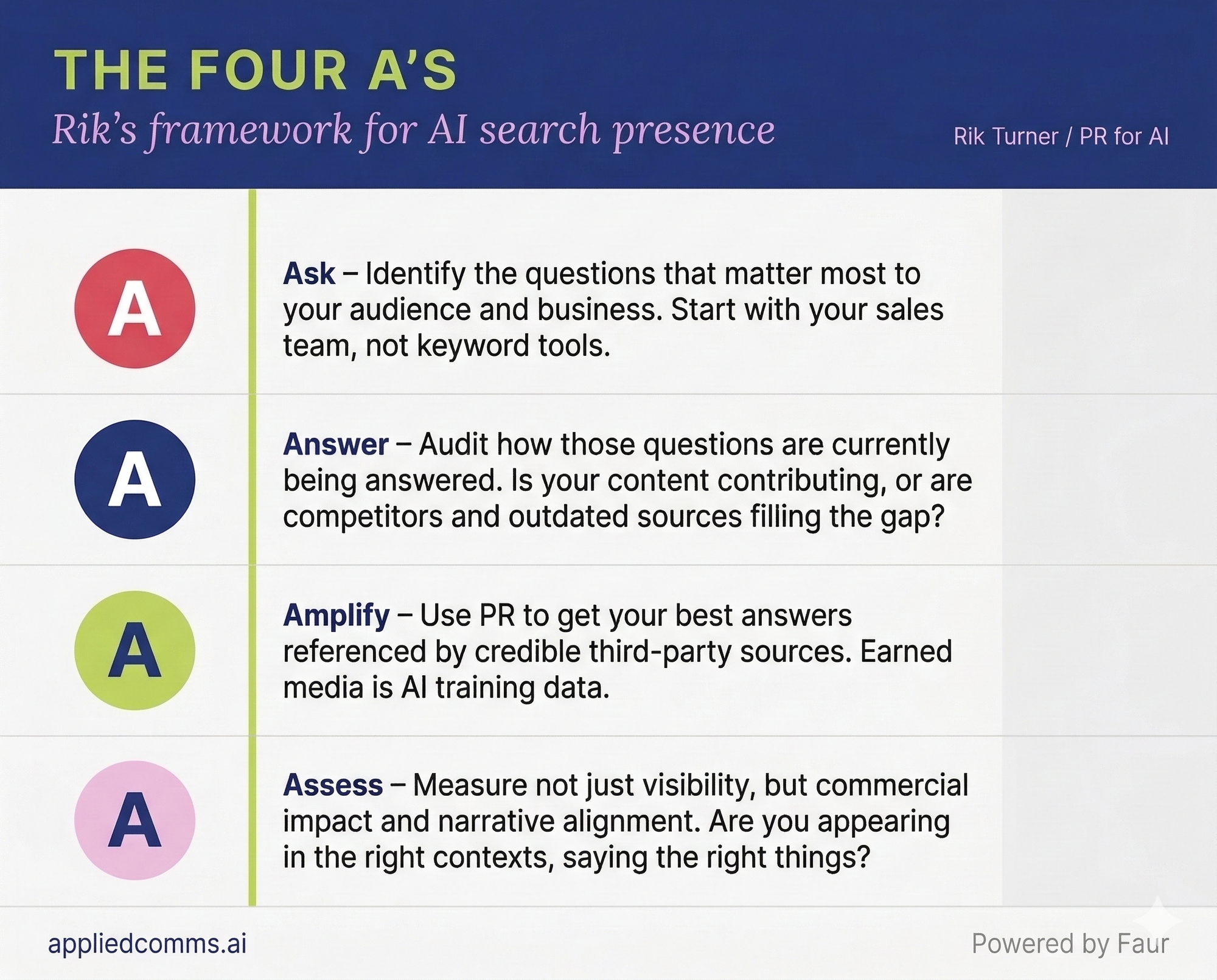
For teams who want to get a handle on their AI search presence without becoming specialists overnight, Rik has developed what he calls the Four A's framework.
- Ask – what are the questions your audience is actually asking? The most valuable input here often comes from sales teams, before researching with keyword tools. What do prospects want to know before they engage?
- Answer – how is that content being answered, and is your owned content contributing? This is the audit phase: do you have material that addresses these questions authoritatively, or are competitors, commentators, or outdated sources filling the gap?
- Amplify – this is where PR comes back in. Getting your answers referenced by credible third-party sources extends your reach into AI training data in the way that owned content alone cannot.
- Assess – measure impact. Not just AI visibility scores, but commercial outcomes. Are you being mentioned in the right contexts? Is it influencing downstream behaviour?
For teams who want to start right now without specialist tools, Rik's minimum viable audit is simple: pick three to five questions your customers most frequently ask. Test them in any AI platform – even the free versions. See what's being said, check the sources, and map the gaps. "You can do a lot in 15 to 30 minutes," he says. "You don't need fancy tools to understand where you stand."
A red/amber/green prioritisation helps teams act on what they find: red for inaccuracies that need immediate attention, amber for outdated information that's drifting, green for the narratives that are already working.
On Comms Teams and the Fear of More Work
A consistent thread in Rik's work with teams is the anxiety that AI search is yet another demand on already stretched practitioners. He's direct about this.
"Something I'm very conscious about is that I don't want to be creating additional work for teams," he says. "Quite often it's just reassuring them: the work you're already doing is super valuable. Sometimes it's just slight tweaks – or even just articulating the value of what you're already doing in a new way."
One of the smallest and most effective changes he recommends: audit your spokesperson bios. Not a comprehensive overhaul – just check that every bio, byline, and quote attribution includes not just the person's name and company, but what problem the company solves for which audience. Half a sentence. "Rather than 'this person from this company said this', it becomes 'this person from this company, which provides this solution for this audience, said this,'"
- Good: "says Rik Turner, founder of PR for AI"
- Better: "says Rik Turner, founder of PR for AI - an independent consultancy providing SEO & GEO training for PR teams"
Rik explains. "That context is what AI systems use to understand what you do."
For larger organisations, the challenge is usually internal alignment rather than capability – getting performance marketing, SEO, PR, and content teams speaking the same language around AI search objectives. For smaller teams and scale-ups, it's more often about finding practical starting points and relevant resources. Either way, Rik's instinct is to start light and iterate.
What's Next: Narrative Alignment, Not Just Visibility
One thing Rik is building that doesn't exist yet in the tools landscape: a way to measure not just whether a brand is visible in AI results, but whether those results align with what the brand actually wants to be known for. Most AI monitoring tools track mentions and sentiment. None of them track narrative alignment – whether AI is associating your brand with the problems you solve, the audiences you serve, the positioning you've worked to establish.
"It's not just about being visible," he says. "It's about what's being said."
That distinction – between visibility and narrative – is probably the sharpest thing Rik brings to this space. And it's a distinction that PR and comms professionals are uniquely equipped to act on, if they understand why it matters.
Connect with Rik on LinkedIn or explore his work at prforai.co.uk.
This interview is part of Applied Comms AI's Leader Interviews series – conversations with communications professionals navigating the practical realities of AI implementation. Applied Comms AI is powered by Faur.
For anyone wanting to start immediately, the monitoring and reporting templates at Comms With AI – particularly the Weekly Monitoring Brief – provide a practical starting structure for tracking what AI is saying about your brand alongside traditional coverage.
Next up: AI Agents for Comms Leaders – masterclass webinar series

A six-part Applied Comms AI masterclass series on building agent-based workflows for communications teams – from planning and production through to governance, monitoring, and organisational change.
View sessions and register: https://www.appliedcomms.ai/events/
Work With Faur / Applied Comms AI
Applied Comms AI helps communications teams move from AI experimentation to operational value. Through Faur, we offer workflow audits, implementation consulting, and capability-building workshops—grounded in the same hands-on approach you see in this content. If you're exploring how AI could transform your communications practice, drop us a line at info@faur.site or book a consultation session.