The Work Before the Work: Comms With AI in the Strategise Phase
Most AI conversations in communications start with the draft. That framing misses where quality is actually set – in the research, positioning, stakeholder mapping, and message architecture that happens before a single sentence gets written.


Most AI conversations in communications start in the wrong place – like you're tuning in only right at the end of your favourite soap opera.
They start with the draft – the press release, the social post, the executive briefing – and ask how AI can make the drafting faster. That framing concedes too much. It assumes the quality of the output depends mainly on how well the writer handles the last mile.
In practice, the quality of any communications work is set long before the drafting starts. It is set in the research, the positioning, the stakeholder mapping, the message architecture, the objectives.
It is set in the work that senior communicators do when they are thinking rather than typing. When that upstream work is weak, no amount of polish on the draft can save it. When it is strong, even a rough draft tends to land.
This is the Strategise phase of the Comms With AI (CWAI) Operating System: the intelligence and planning layer that informs everything downstream. It is where AI agents are starting to change how senior leaders think, not just what they produce.
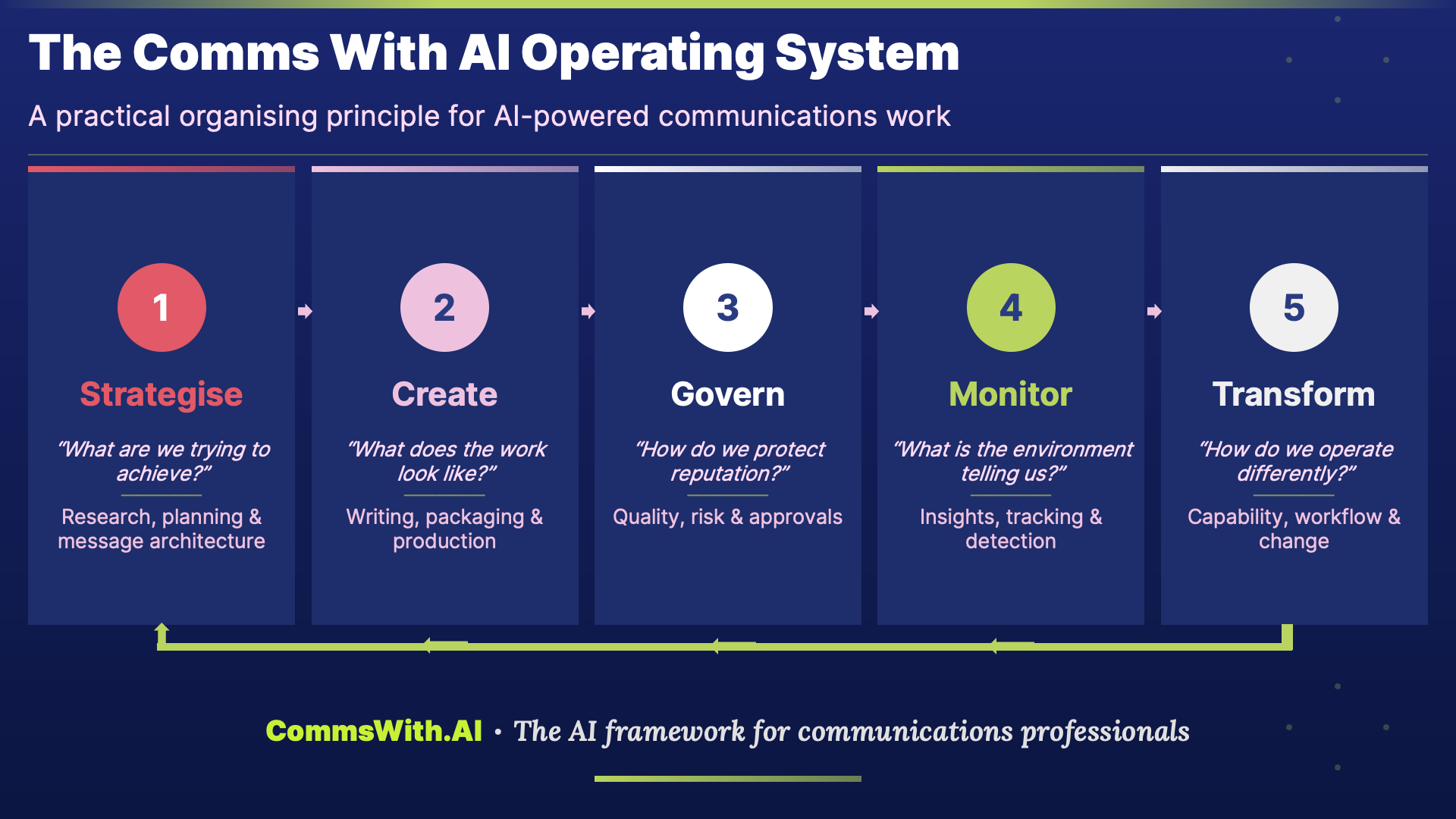
If you missed the first article in this series, it introduced the Operating System and its five phases: Strategise, Create, Govern, Monitor, Transform. You can find the full series here. This second article goes deep on the first phase — where most strategic communications work actually begins.
The Strategic Rigour Problem
Senior communicators have always lived with a quiet tension.
The strategic groundwork they know the work needs – proper audience analysis, rigorous stakeholder mapping, a defensible message architecture, a clear landscape read – takes time. The brief they have been handed, or the crisis they are responding to, or the launch they are supporting, often does not allow for that time.
What gets compressed first is the thinking. The kick-off meeting becomes the strategy. The gut feel becomes the audience insight. The creative director's instinct becomes the positioning. The work ships on time, and owing to experience and savvy know-how will still be of high quality, but the rigour behind it is thinner than anyone would admit in public.
This is not a failure of the team, far from it! It is a structural constraint. Strategic work at the level it deserves has never been scalable, because it depends on experience, synthesis, and judgement. Until recently, there was no way to do it faster without doing it worse.
AI Agents start to change that equation. Not by replacing the judgement – that part remains resolutely and stubbornly human – but by collapsing the time spent on the groundwork that informs it.
What the Strategise Phase Covers
Strategise is the broadest phase of our CWAI Operating System. It holds everything that happens before a single sentence gets drafted:
- Research and intelligence: landscape analysis, competitive monitoring, trend identification, sectoral reading
- Audience work: segmentation, profiling, psychographic analysis, channel behaviour mapping
- Stakeholder engagement: mapping, prioritisation, engagement planning, influence analysis
- Positioning and messaging: message architecture, narrative design, proof point organisation, differentiation
- Planning: campaign briefs, communications plans, channel strategy, objectives, measurement frameworks
On CommsWith.AI, the Strategise phase currently holds 20 templates — the largest of any phase. That density reflects the reality of senior communications work: most of the intellectual load sits upstream of production.
Messaging frameworks, audience profiles, and stakeholder maps are strategic outputs, not creative ones – it's also all an indicator of how central communications is to well-performing companies. (All us comms pros can and should take a bow here, though not for too long – after all, time is pressing...)
The 20/80 Rule for Strategise
Across the CWAI Operating System, the general rule is roughly 30% AI, 70% human judgement. Strategy tilts further toward the human side. For the Strategise phase specifically, the right (still rough) balance is closer to 20/80. AI handles research, structuring, and first-pass synthesis; humans handle interpretation, prioritisation, and judgement about what matters.
This ratio shifts across the five phases:
- Strategise: 20/80 – research and synthesis AI, judgement human
- Create: 35/65 – drafting AI, voice and nuance human
- Govern: 25/75 – systematic checking AI, reputational judgement human
- Monitor: 40/60 – pattern detection AI, interpretation human
- Transform: 20/80 – readiness assessment AI, change leadership human
Strategy is where AI earns its place least automatically. Agents can give you a landscape map in an hour that would take a researcher two days. They cannot tell you which parts of that map matter, which stakeholders to prioritise, or which proof point will land with a sceptical board. That is the 80%. Getting the 20% right still buys you meaningful capacity.
Where Agents Change Strategic Work
Four specific applications are worth examining in detail, because they are the areas where the change is most tangible.
1. Landscape analysis and competitive intelligence
Traditional landscape work involves a researcher trawling through competitor websites, annual reports, media coverage, and analyst commentary to build a view of how a market is positioning. It is thorough, necessary, and slow.
A landscape analysis agent can run the same scan in a fraction of the time. Give it five competitors and a focus area (positioning, narrative pillars, channel mix, tone of voice), and it will return a structured comparison in under an hour. The Competitor Comms Audit template on CommsWith.AI is built for this kind of agent-supported analysis — it defines the structure so the agent's output is usable immediately.
The catch: agents surface what is publicly available. They do not know which competitor is about to pivot, which is struggling internally, or which is about to lose a key executive. That context still comes from network and experience.
Tools that work well here: Perplexity for synthesised web research, Claude or ChatGPT with deep research modes for structured competitive analysis, Gemini for Google-adjacent intelligence. Each has strengths: in my own testing, Perplexity is fastest for surface scans, ChatGPT is best for structured analysis output, and Gemini is strongest when the analysis involves Google Search data specifically.
2. Stakeholder mapping at scale
Stakeholder maps are one of the most undervalued strategic tools in communications. Done properly, they are the foundation for every engagement decision downstream: who gets what message, in what order, through what channel, with what rationale.
Done quickly, they are a list of names on a power/interest grid (which usually then sits hidden away in a shared folder, unloved and unused).
Agents sit between the two. They can take a list of stakeholders, pull public information about each, and produce a structured assessment across dimensions that would take a junior strategist a full day to compile manually: current public position, channel preferences, recent statements, likely concerns, probable response to the organisation's planned message.
The Stakeholder Mapping Matrix on CommsWith.AI provides the structure; agents do the legwork. The strategic call – who actually matters, who to engage first, where the risks are – remains with the team.
Do bear in mind that agents are still prone to getting details wrong – and occasionally conjuring up details (and in extreme cases even imaginary people). You still want/need that human review to vet details, and also add anything else that has been missed. This remains a time-saving tool, definitely not a one-and-done solution.
3. Audience profiling from unstructured data
Audience work used to be a specialist discipline requiring research budgets and timelines that most comms teams do not have. The shift to agent-assisted profiling has been one of the more practical wins of the last twelve months.
Feed an agent a collection of unstructured inputs – survey responses, sales call transcripts, customer support tickets, social listening data, reviews – and ask it to build audience segments with consistent structure: motivations, barriers, language patterns, channel preferences, trigger moments.
The output is not a replacement for proper qualitative research, but it is a dramatic step up from the assumptions that usually stand in for audience insight in fast-moving work. It also throws up insights you may not have previously considered, and of course you can then converse with your tools of choice to dig deeper.
The Comms Audience Profile template and Audience Segmentation Worksheet on CommsWith.AI are both designed to take agent-generated profiles and structure them for team use.
4. Message architecture and positioning
Positioning work is where many senior communicators are most sceptical about AI, and with good reason. Positioning involves trade-offs, long-horizon judgement, and sensitivity to organisational politics that agents cannot touch.
But positioning also involves a lot of structured groundwork: clarifying the competitive set, surfacing differentiation candidates, stress-testing proof points, and generating multiple framings for the same underlying idea. That groundwork is where agents can earn their keep.
The Message House, Positioning Statement Generator, and Proof Points Bank templates are built around this workflow: agent produces structured first-pass outputs, human makes the judgement calls about which framing wins, which proof points carry weight, and where the narrative lives.
Three Examples From Practice
The following are drawn from real client work, anonymised and simplified to protect confidentiality. They show how the Strategise phase operates in practice, across different sectors and timelines.
Example 1: A membership body navigating a regulatory shift
A professional membership body commissioned strategic communications support ahead of an anticipated regulatory change that would affect around 60% of its members' working practices. The team had six weeks to build a position, develop a narrative, and prepare member-facing communications before the change was announced.
The Strategise phase ran in the first ten days. Agent-supported landscape analysis mapped how comparable bodies in adjacent sectors had handled previous regulatory shifts — which positions had held up well, which had backfired, and which had quietly been abandoned. A parallel stakeholder mapping exercise identified thirty named individuals across regulators, media, member associations, and vocal members whose early response would shape perception.
The agent did the compilation. The strategic call — to lead with a specific framing rather than the obvious one — was made in a 90-minute working session with the CEO and chair, drawing on the agent-produced groundwork but departing from its implied direction on two key points. The work that may have taken a research team two weeks – a window way too wide for this situation – was compressed into a couple of days. The weeks that followed could then be focussed on areas including narrative refinement, spokesperson preparation, and member engagement.
Example 2: A scale-up preparing for a funding announcement
A Series B software company needed to position an eight-figure funding round. The comms lead had two weeks, limited research support, and a founder who wanted the announcement to land in tier-one business media as well as sector press.
The Strategise phase began with agent-assisted competitive intelligence on how comparable companies had positioned their recent rounds: which narratives had landed, which had been ignored, and which spokespeople had been treated as credible in business media versus sector media. The agent also profiled the journalists most likely to cover the story, drawing on their recent output to identify which angles would resonate and which would not.
The resulting message architecture distinguished between the sector-media narrative (product capability and customer outcomes) and the business-media narrative (market opportunity and founder story). The founder initially pushed for a single unified message; the agent-produced evidence that the two audiences responded to different framings carried more weight in the strategic conversation than the comms lead's instinct alone could have.
The announcement landed in three tier-one outlets and six sector publications, with distinct but aligned framings in each. The strategic differentiation was the single highest-impact decision in the campaign; the agent work supporting it took six hours over two days.
Example 3: A non-profit planning a three-year campaign
A national charity commissioned a three-year awareness and behaviour-change campaign on a contested social issue. The Strategise phase ran for six weeks before any production work began: unusually long, because the strategic stakes were high and the topic's sensitivity meant mistakes would be expensive.
Three pieces of agent-supported work shaped the campaign. First, a landscape analysis of every major campaign on the same or adjacent issues over the previous ten years: what had moved public attitudes, what had backfired, and what had plateaued. Second, a stakeholder mapping exercise covering 120+ named individuals and organisations across policy, media, academia, and lived-experience communities. Third, a message architecture exercise that tested 15 framings against the audience insight, narrowing to three that the team then refined manually.
The agent work did not make the strategic decisions. It compressed the time spent on the inputs to those decisions from what could have been months to six weeks, and raised the quality floor of the analysis, making the team's strategic conversations better informed. The campaign is now in year two, tracking ahead of its attitudinal targets, though outcome metrics will not be available for another eighteen months.
A Test Your Strategy Should Pass
If you are unsure whether your Strategise work is strong enough, run it against the following five questions before moving to Create. These are not academic; they are the questions a sceptical board member, a sharp journalist, or a new CEO will likely ask within minutes of reading your plan.
1. Can you name your primary audience in one sentence, without hedging?
If the answer contains "and" more than once, you have very likely not segmented properly. "Mid-market CFOs in regulated industries" is a primary audience. "CFOs, COOs, and risk leaders in finance, healthcare, and energy" risks feeling like a spreadsheet.
2. What is the single sentence you want your primary audience to repeat after reading your work?
If you cannot write it down, your team will struggle to deliver it.
3. What are the three proof points a sceptic would need before believing your main claim?
Not your three favourite proof points. The three that would move someone who begins the conversation doubting you, and leaves feeling persuaded in the right direction (if not fully converted!).
4. Who are the five stakeholders most likely to shape how this lands, and what do you know about their recent public positions?
Not who you would like to influence. Who actually influences the outcome.
5. How will you know in 90 days whether this worked?
The objective needs to be specific enough that you can bet on it.
If your strategy passes all five, you are ready for Create. If it fails any of them, the work to fix it belongs in Strategise — not downstream, where the cost of the gap increases the further you go.
Where To Start
If the Strategise phase is the part of the Operating System your team is weakest in – which it likely is, because strategic rigour is where time pressure bites first — three starting points are worth considering.
- Start with landscape analysis. It is the lowest-risk agent application, the highest-velocity time saving, and the easiest to evaluate. If your team is spending more than a day on competitive intelligence for any single engagement, agent support will likely pay for itself in the first use.
- Then move to stakeholder mapping. The structural nature of the work suits agent support, the templates on CommsWith.AI give you a usable framework immediately, and the quality uplift is visible to anyone reviewing the output.
- Audience profiling and message architecture are the more advanced applications. They're worth building toward once the simpler workflows are embedded, because they require clearer judgement about when to trust agent output and when to push back on it.
The twenty templates in the Strategise phase on CommsWith.AI are all designed to support this kind of agent-assisted strategic work. They provide the structure that makes agent output usable, and they hold the team's judgement at the points where judgement matters most.
Browse the full Strategise phase on CommsWith.AI.
Join the Discussion Session
This article has a companion session on Wednesday 29 April at 1.30pm: a free, small-group discussion for senior communicators working on AI implementation in their teams. Not a masterclass — a conversation. A chance to compare notes on how the Strategise phase is playing out in real organisations, surface the practical challenges that do not make it into case studies, and pressure-test how the Operating System applies to your own context.
Register for the Strategise discussion session on Eventbrite.
Sessions for Create, Govern, Monitor, and Transform will follow the same format as the series progresses.
What Comes Next
Article 3 in this series covers the Create phase — where strategy becomes content, at scale and under pressure. It is where the AI contribution rises to 35/65, and where the volume pressures on communications teams are most visible.
If your team is working on the Strategise phase and you want to compare approaches, I am always happy to hear from fellow practitioners at michael@faur.site.
About Applied Comms AI
Applied Comms AI is the practical guide for communications leaders navigating AI — grounded in hands-on experimentation, workflow transformation, and real-world implementation. Read the full AI Agent series here.
About Comms With AI
CommsWith.AI is the template and resource library for communications professionals using AI. The Strategise phase library contains 20 templates covering audience analysis, stakeholder mapping, positioning, message architecture, and campaign planning.
About Faur
Faur is a communications consultancy pioneering practical AI expertise for organisations ready to implement at scale. If your team is working on the Strategise phase and needs bespoke support — strategic frameworks, agent deployment, or capability development — get in touch at michael@faur.site.
This article is part of the AI Agent series published on Applied Comms AI. The series maps to the Comms With AI Operating System: Strategise, Create, Govern, Monitor, Transform.