The Lag Problem: Comms With AI in the Monitor Phase
Most monitoring tells comms teams what happened after the moment to act has passed. The Monitor phase asks a sharper question: how quickly can your team detect, interpret and respond to what is happening now?


Picture your typical Monday coverage report.
It arrives at the start of the week and summarises what was said about the organisation over the previous seven days: the coverage, the mentions, a sentiment read, a few competitor notes. Someone spent real time assembling it. It is thorough, it is tidy, and it is a history lesson. Everything in it has already happened. The story that mattered most broke on Wednesday, and the window to shape it closed on Thursday, two working days before the report that mentioned it landed.
This is the lag problem: the gap between something happening and the communications team knowing enough to act. Most teams monitor in the rear-view mirror, learning accurately and late what the road behind them looked like. This of course can be and often is incredibly useful, but the Monitor phase of the Comms With AI Operating System asks a different question: how small can that gap be?
The real prize of agent-assisted monitoring is not a cheaper coverage report. It is a shorter distance between signal and response.
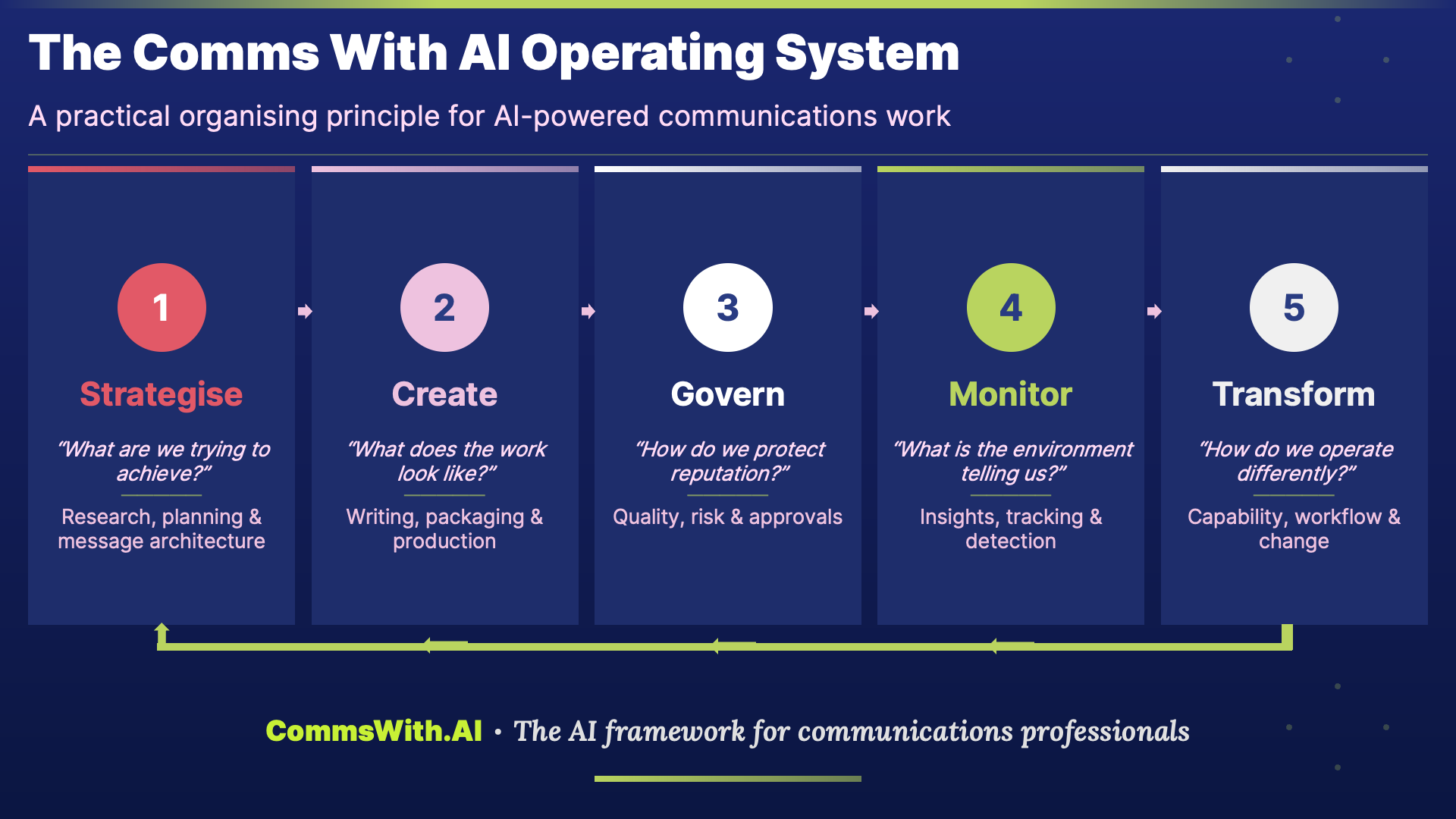
New to the series? The overview introduces the Operating System and its five phases, and the earlier articles cover Strategise, Create and Govern. You can also read the full series here. This fifth phase reads the environment and feeds everything it learns back into the first.
The Lag Problem
Traditional monitoring can fail comms teams in three connected ways, and agents address each one differently:
- The first is time. The insight arrives after the moment to use it. A weekly report is a structural decision to be several days behind the conversation. For a settled organisation in a quiet sector, that is survivable. For anyone exposed to a fast news cycle, it means the team routinely learns about what matters too late to respond well.
- The second is volume without signal. Most teams are not short of monitoring data; they have alerts, listening tools and dashboards producing a constant stream of it. What they lack is the human time to turn that stream into the few things that actually matter. The data scales effortlessly. The interpretation does not. So teams either drown, scanning everything and absorbing nothing, or quietly ignore most of the feed and hope the important item was not in the part they skipped.
- The third is the dead end. Even timely, sharp insight often goes nowhere. It lands in a report, the report is read or it is not, and the loop closes there. What the team learned rarely reaches the people doing the strategic work, where it could change a decision.
Most monitoring failures are not data failures; they are time, signal and feedback failures. Agents change the economics of all three, which is what makes Monitor the phase where AI earns its highest share of the work.
What the Monitor Phase Covers
Monitor is the intelligence layer of the CWAI Operating System. It holds everything involved in reading the external and internal environment and turning it into something the organisation can act on:
- Media and social monitoring: tracking coverage, mentions and conversation across owned, earned and social channels
- Issue tracking and escalation: spotting emerging issues, judging trajectory, deciding what needs attention
- Sentiment and narrative analysis: not just whether the tone is positive or negative, but which narratives are forming
- Campaign performance measurement: tracking whether communications work is doing what it was designed to do
- Competitive and stakeholder intelligence: watching how others in the field are positioning and moving
- Reporting and briefing: turning all of the above into something a busy leader can absorb in two minutes
The phase before this one, Govern, protects the organisation from what it publishes. Monitor protects it from what it has not noticed.
The 40/60 Rule for Monitor
Across the Operating System, the working rule is roughly 30% AI, 70% human. Monitor is the one phase where AI does more than the average, at 40% AI, 60% human, the highest AI share in the framework.
This ratio shifts across the five phases:
- Strategise: 20/80 – research and synthesis AI, judgement human
- Create: 35/65 – drafting AI, voice and nuance human
- Govern: 25/75 – systematic checking AI, reputational judgement human
- Monitor: 40/60 – pattern detection AI, interpretation human
- Transform: 20/80 – readiness assessment AI, change leadership human
Monitor tilts furthest toward AI because the core task suits agents almost perfectly. It is high-volume, continuous, pattern-detection work that rewards tirelessness and consistency. No communications professional can watch every channel without fatigue. An agent can.
But 40/60 still leaves the majority of the work with people. An agent can tell you that mentions are up, that a phrase is recurring, that sentiment has shifted. It cannot reliably tell you whether that matters. Unless the system has been set up to weight sources properly, it may not know that a recurring phrase came from one influential account rather than two hundred irrelevant ones, or that a sentiment dip is the predictable noise around a product update rather than a genuine problem. And it cannot make the escalation call, because escalation is a judgement about consequences, and consequences depend on context the agent does not have.
So the division in Monitor is unusually clean. Agents do the watching. Humans do the meaning.
Where Agents Change Monitoring Work
Four applications are where the change is most tangible:
1. Always-on detection and anomaly alerting
This attacks the lag problem directly. Instead of a person assembling a report on a schedule, an agent watches continuously and stays quiet until something is worth saying. It learns the normal pattern, the usual volume of mentions, the usual mix of channels, the usual sentiment range, then flags departures from it: a sudden rise in mentions, a sentiment movement outside the normal band, a new account entering the conversation with reach, a phrase appearing repeatedly that was not there yesterday.
The shift is from a report to an alert. A report tells you what happened on a timetable; an alert tells you something is happening now, while you can still do something about it. For any organisation exposed to fast-moving risk, this is the single most valuable thing the phase offers.
Two potential hitches here. The first is calibration: an agent set too sensitive becomes a smoke alarm that goes off when you make toast, and a team that has learned to ignore its alerts is worse off than one with no alerts at all. Finding that balance is a matter of judgement, relying on your expertise. The second is source quality. The first monitoring design question is not which model to use; it is which sources matter enough to watch. An agent reading the wrong feeds will confidently miss the right story – much as we ourselves often do nowadays in a media ecosystem drowning in poorly generated slop.
2. Sentiment and narrative analysis
Sentiment scoring, on its own, is a crude instrument – surely it's not just me continuously frustrated by it? "62% positive" feels informative and rarely is; it collapses a complicated conversation into a single dial and tells you almost nothing about why.
Narrative analysis is the more useful application. Rather than scoring tone, an agent reads across a body of coverage and identifies the narratives forming inside it. Not "sentiment is down" but "a specific framing of this issue is gaining traction, it started in one place, and it is being picked up in these terms." That tells you what story is being told about you, who is telling it and whether it is spreading, the thing a communications leader actually needs in order to decide whether and how to respond. It connects directly to the shift toward AI-mediated search and visibility that Rik Turner described on this site. What stays human is the judgement about which narrative is a genuine threat and which is background noise that will fade on its own.
3. Briefing automation
This gives a team the most time back. The work of turning raw monitoring data into a readable brief is real, skilled and almost entirely automatable. An agent can take the feeds and produce a short daily or weekly brief in a consistent structure: what changed since the last brief, what it appears to mean, and what, if anything, needs a decision. A human reviews it, corrects the interpretation, adds the context the agent could not have, and sends it. The brief that used to take half a day takes twenty minutes to check.
This is territory the site has tested before: the earlier review of ChatGPT's deep research capability was, in effect, an examination of how well an agent does this kind of synthesis-and-summary work, and where it still needs a human hand. The Weekly Monitoring Brief and Monthly Stakeholder Update templates on CWAI give that output a structure the team can rely on, so the brief reads the same way every time.
4. Predictive and early-warning intelligence
This is the application with the most promise and the most need for honesty.
The genuine version is real and useful. By tracking the early shape of issues, an agent can flag that something is on a trajectory that has, in the past, led to escalation: a small concern raised in more places, by more credible voices, in increasingly specific terms. That pattern often does precede a bigger story, and surfacing it early buys the team the rarest thing in communications, which is time. A signal is only useful, though, if the team knows what level of response it triggers, which is why early warning has to be paired with clear escalation thresholds, the job the Issue Log Tracker is built to do.
The overstated version is everywhere in vendor marketing and should be treated with suspicion. An agent does not predict the future; it extrapolates from patterns in the past. It is useful for the issue that follows a familiar curve and structurally blind to the genuinely novel event: the thing with no precedent in the data, which is very often the one that does the most reputational damage. "Predictive" is a fair description of trend extrapolation and a false one for foresight. Use the capability, value it, and never let it persuade the team that the unprecedented has been ruled out.
What it looks like in practice
A charity launches a policy campaign on Monday. By Tuesday afternoon, an agent flags that a hostile framing is being repeated across three local outlets and one sector influencer, ahead of any coverage the team had clocked. They get the alert, update the FAQ, re-brief the spokesperson and adjust the paid social copy before the framing hardens into the dominant story. Monitor detected it, Govern checked the response, Create produced it, and the next Strategise cycle inherits a sharper read of how that issue travels. That is the loop working as designed.
A Test Your Monitoring Should Pass
Run your current monitoring against these five questions. They separate monitoring that informs decisions from monitoring that documents the past.
- If something broke about your organisation right now, how long before you would know? Be honest, and count in hours. If the answer is "the next report", you do not have monitoring. You have a record.
- Does your monitoring produce decisions, or only reports? Look at your last month of output and find the decisions it changed. If you cannot point to any, it is running as an archive, not an intelligence function.
- Can you tell signal from noise, or are you tracking everything equally? Monitoring everything is the same as monitoring nothing, because the one item that matters is buried in the thousand that do not. A working setup is mostly a definition of what counts.
- Does what you learn in Monitor actually reach the people doing Strategise? If insight stops at a report and never reaches the people making strategic decisions, the loop is broken. The feedback path has to be deliberate; it does not happen on its own.
- What did your monitoring miss last quarter, and why? Every setup misses things. A team that can answer this is tuning a system. A team that cannot is trusting one it has never tested.
Pass all five and it is genuinely an intelligence function. Fail any and the gap is in the Monitor phase, almost certainly costing you response time you cannot see.
Where To Start
If Monitor is the phase your team has under-resourced, which is common, because it competes with the more visible work of producing things, start with three moves.
First, replace one manual report with an agent-drafted, human-reviewed brief. Choose the report that takes the most time and changes the fewest decisions. It is the fastest visible win in the phase and frees real capacity immediately.
Second, set up anomaly alerting on your organisation's name, senior leaders, core products and live issues. Keep the first version deliberately narrow, and expect to spend a few weeks tuning the sensitivity. A noisy system will not survive contact with a busy team. That tuning is the work, and it is worth it.
Third, define the feedback route into Strategise. Decide, explicitly, who sees monitoring insight, how often, and what kind of finding is allowed to change the plan. The best monitoring output is not the report itself. It is the change it causes in the next campaign brief, message house, stakeholder map or leadership decision. This is the step teams skip, and skipping it is what turns monitoring into an archive.
The templates in the Monitor phase are built around this logic: continuous agent detection feeding human interpretation, with the output structured so it informs decisions rather than filling folders. Start with the Monitor templates on Comms With AI: the Weekly Monitoring Brief, Issue Log Tracker and Simple Comms Dashboard. (BTW If you need to design a monitoring system that feeds strategy rather than fills folders, Faur can help build the workflow, escalation logic and briefing structure around it. Do get in touch!)

Join the Discussion
On 1 July I am hosting the next live Applied / Comms With AI Leader Interview, The Two Clocks: Elif Güvençer on repositioning comms for the AI era, a conversation about the structural choice facing every communications function as AI reshapes what the work is for, not just how fast it gets done. It is free, online and recorded. Register here; if you cannot make the slot, sign up anyway and we will send the recording and write-up.
What Comes Next
Article 6 is the final piece in the series, and it covers the Transform phase: building the communications organisation that can sustain all of this. The AI contribution drops back to 20/80, because Transform is not really about tools at all. It is about roles, skills, culture, and the difference between a workflow improvement that sticks and a pilot that quietly fades. It is also where the loop closes, because Transform feeds back into Strategise, and the cycle begins again.
If your team is working on Monitor-phase implementation and you want to compare approaches, I am always happy to hear from fellow practitioners at michael@faur.site.
About
Applied / Comms With AI is the practical guide for communications leaders navigating AI, grounded in hands-on experimentation, workflow transformation and real-world implementation. Read the full AI Agent series here. Comms With AI is the companion template and resource library for communications professionals using AI, and the Monitor phase library covers media and social monitoring, issue tracking, sentiment and narrative analysis, briefing and stakeholder reporting. Both sit alongside Faur, a communications consultancy pioneering practical AI expertise for organisations ready to implement at scale. If your team is working on the Monitor phase and needs bespoke support, whether monitoring design, early-warning systems or intelligence that feeds back into strategy, get in touch at michael@faur.site or connect with me on LinkedIn.
This article is part of the AI Agent series published on Applied / Comms With AI. The series maps to the Comms With AI Operating System: Strategise, Create, Govern, Monitor, Transform.