The machine speaks our language: why AI makes communications fundamental, not just more important
AI systems are built on language, steered by language and increasingly speak on an organisation's behalf. That makes communication part of how the technology behaves, and hands comms a job nobody else in the building is trained for.


The Brief
- The claim to earn: "AI makes communications more important" is exactly what you would expect a communicator to say. So what is the case to make, when the production layer is being automated and three quarters of respondents to Muck Rack's survey already use generative AI?
- The increased centrality of comms to our day to day: the assistants and agents now speaking for organisations are made from language: trained on it, briefed in it, answering in it, all day, to everyone who asks.
- The takeaway: there are three places that work now happens, at the input, on coherence and on trust consequence, and it is work comms has barely begun to claim. Communications as a practice is built for it, working alongside the people responsible for the systems. One afternoon's exercise below to find out where yours stands.
The Story
In our live Leader Interview with Applied / Comms With AI back in July, Elif Güvençer described a scene most of us have already watched. You ask an organisation's AI assistant a few routine questions and the answers come back clean. Then you ask a hard one, something about a live controversy involving the chief executive, and it says: "I can't answer that."
Her point was that the refusal is itself a reputational event. It is a spokesperson freezing on camera, except it happens all day, to everyone who asks, on a surface the organisation barely knows it is speaking from. Two months on, the examples keep arriving, and the ones that worry me most are the agents that do not freeze. In July the toilet-paper brand Who Gives A Crap sent a subscription email with a typo that appeared to halve the roll count. When a customer queried it, the company's AI email agent apologised for the "unclear messaging" and then confirmed the wrong price, politely and in full sentences. The company switched the agent off as soon as it found out. The report does not say which controls failed, and I would not guess; what it shows is an agent reinforcing an error in confident, well-formed language.
We talk endlessly about whether AI will replace communicators. Those stories point at a more useful question: what is AI actually made of, and who in the building is trained to work with that material?
The uncomfortable part
Any communicator claiming AI makes their job more important has to clear a low bar of suspicion, because it is exactly what you would expect us to say. With that in mind, let's concede the ground that is lost before arguing for the ground that is not.
A large share of what comms has historically been paid for is being automated: drafting, versioning, monitoring, first-pass analysis. In Muck Rack's State of AI in PR survey, 76% of respondents said they used generative AI, up from 75% in 2025. Elif put the risk more sharply than most of us dare to. She calls it "mandate compression": you end up with territory you can no longer occupy, because you never redesigned yourself to occupy it. Her reading was that much of the profession's value proposition is output-based, whether we admit it or not, and the output layer is the bit the machine does now.
The job we quietly conflated
Here is what the automation reveals rather than destroys. Producing language and governing meaning were always two different jobs. We conflated them because the same people often did both. You wrote the release and also decided what the release should and should not say, so it felt like one skill.
AI has pulled them apart: it generates fluent language at enormous scale and near-zero cost. What it cannot do on its own (at this time, anyway!) is decide whether that language is true, coherent across every surface at once, appropriate to this audience in this moment, and aligned with what the organisation needs to be understood as. It has no judgement about what to leave unsaid unless someone gives it some. That judgement was the expertise the typing hid: the subtle art of communications.
The Who Gives A Crap reply is the distinction in one exchange: the language was courteous, apologetic and clear, and the content was wrong. You can see the profession already behaving as if it knows this. In the same Muck Rack survey, 91% of respondents said they always edit AI output before it goes anywhere. That editing is the governance job, done by hand, on top of the production job the machine now largely covers. It was also the thread running through our 2026 communications trends piece: as the tools get smarter, the sharper human voice matters more.
What the technology is actually made of
Here's the claim I can and shall firmly defend, which is stronger and less self-serving than "comms matters more."
Communication is no longer only how we describe the organisation. It has become part of how the technology behaves. The systems we are talking about, large language models and the assistants and agents built on them, are made from language: trained on it, instructed in it and, increasingly, speaking it on our behalf. You steer a model with words. Its behaviour is shaped by how it is briefed, framed and constrained. The interface is a sentence. Framing, audience, tone, the discipline of saying the true thing well and leaving the wrong thing unsaid: these are the material the technology runs on, which means communicators can help shape the system as well as narrate it, alongside the engineers, product owners and lawyers responsible for the service.
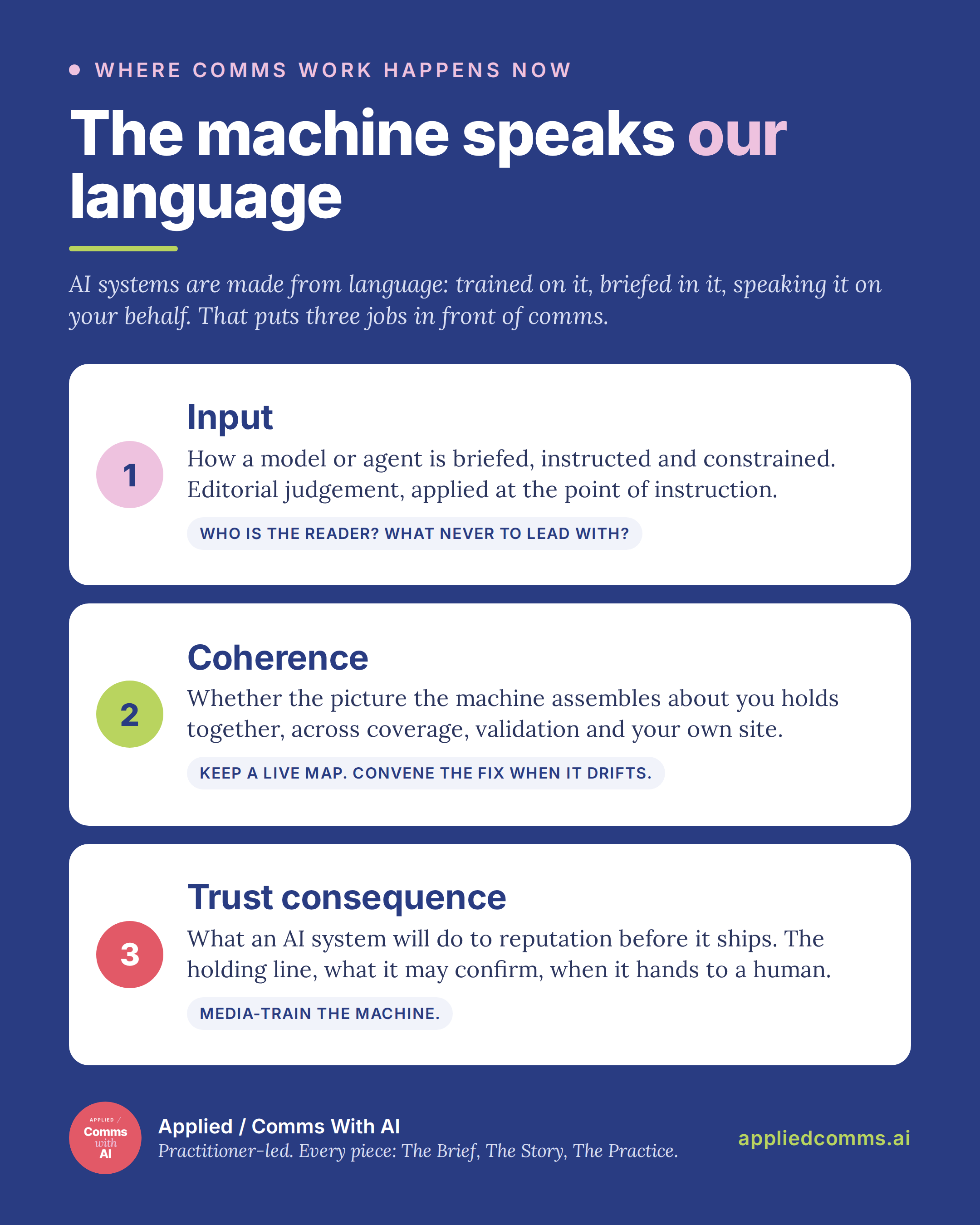
There are three places that work happens:
- Input. How a model or an agent is briefed, instructed and constrained. This is editorial judgement applied at the point of instruction. Last summer I built a prompt for media pitch subject lines, and the design decisions in it were all comms decisions. The first version was a one-line ask: write a compelling subject line for my media pitch about our new AI product launch. It produced lines that were accurate, overpromising and indistinguishable from the hundred other pitches in the inbox. The model had the facts and no reader in mind. What fixed it was comms craft, supplied at the input: make the model ask what a good PR person asks first (what is exclusive, what is the timely hook, what is the surprising angle), ask it to weigh news value and what the journalist has covered lately, and make it rate each line for the risk of being ignored and say when to send it. Same brief, same facts, and in my judgement far stronger results, though still with room to sharpen through a human eye. This is the gap between correct language and the right language.
- Coherence. Whether the picture the machine assembles about you holds together. AI answers are stitched from surfaces comms already manages: coverage, third-party validation, the website. It is why generative engine optimisation exists as a discipline at all: answer engines, rather than search result pages, are where a great many people now form a first opinion of an organisation. NOAN founder Neal Mann's argument, in my interview with him, is that AI needs a maintained fact layer beneath the organisation's documents, and that most AI-powered communication is built on sand without one. Reading the whole picture, keeping a live map of it and convening the fix when it drifts is what Elif calls "signal architecture," and it is work comms is well placed to do with whoever else holds a piece of the picture.
- Trust consequence. Understanding what an AI system will do to reputation before it ships. This is where the frozen spokesperson comes back. Elif's fix for the assistant that met the hard question with "I can't answer that" is a reputation protocol: the holding line, what can be confirmed, the tone under pressure, when to hand off to a human. It is exactly what comms writes for a spokesperson before an interview. Elif's observation is that the security on these systems is usually configured and the reputation protocol is usually missing, because nobody saw the machine as a communicator. Whoops!
A glimpse behind the curtain, for how we can better put guardrails in place. Earlier this year I built Plan Comms With AI, a small tool that takes a comms need and returns a brief, a route through the template library and a copy-ready prompt. Its instructions carry two lines I would now call the beginnings of a reputation protocol. One says it must never invent statistics, quotes, client names or endorsements, and must flag a claim that needs evidence rather than fabricate it. The other tells it when to stop being self-serve (a live crisis, regulated or financial or legal claims, redundancies, M&A) and point the user at a human instead. Honest limits: it is a routing tool, not a public spokesperson; the hand-off sits alongside the route instead of replacing it, which I am still not sure is right; and I check it follows those lines by reading outputs, which is a habit, not a test. If you are writing the same for a system of your own, the governance templates in the Comms With AI library are where I would start.
Where the humans stay
None of this is a triumphalist story. When Ford leaned on AI to fix quality problems and let veteran engineers go, it ended up with 350 experienced engineers rehired, newly hired or promoted to rebuild the data pipelines and repair the tools that were meant to replace them, and went on to top JD Power's 2026 initial quality study among mainstream brands. The judgement feeding the machine was a scarce and critical resource all along, and stripping it out was the expensive mistake.
Comms has its own version. Ben Verinder's work on the honesty gap is a reminder that trust is earned by accountable humans. The machine has made the human parts of the job, judgement, coherence and the trust lens, more load-bearing than they have ever been. In the Muck Rack survey, only 12% of respondents said they currently use AI agents in their work. That is a lot of headroom.
In this current phase of AI capability, the technology runs on the material communicators are trained to handle. Comms can bring audience understanding and reputational judgement into how these systems are briefed, tested and allowed to speak, working with the people responsible for them. The organisations that get this right will be the ones where that conversation happened before the agent went live, and not after it failed in public.
The Practice: what you can put into practice today
- Interview one AI assistant that speaks for you. Pick a single AI assistant or agent the organisation runs, whether customer-facing or internal. Write down the five questions stakeholders are most likely to put to it, including the awkward one, and ask them. Record each answer, the evidence it cites and the date. Checking what ChatGPT or Perplexity say about you is a different exercise, worth doing separately.
- Draft the reputation protocol for that system. Write for it what you would write for a human spokesperson: the holding line on the live issue, what it may confirm, the tone under pressure, and the exact conditions under which it hands off to a person. One page. Then take the draft to whoever owns the system and test the five questions together before agreeing any live change, to find where the guardrails work and where they fail and need strengthening.
- Rewrite one brief in comms terms. Take a prompt someone on your team uses every week and add three things: who the reader is, what they have seen already, and what never to lead with. (In some tools, such as Claude, this can be built into a reusable Skill.) Keep both versions and their outputs side by side; it is a small, repeatable way to show a sceptical colleague what this piece is arguing.
Which of the three, input, coherence or trust consequence, has nobody in your organisation looked at yet?
Every Applied piece follows the same shape: The Brief, The Story, The Practice.
Coming up: on Wednesday I'll be putting this argument to Stephen Waddington, former CIPR president and co-editor of AI for Public Relations, in the next Comms With AI Leader Interview: Outputs or Outcomes? Stephen Waddington on the comms teams getting AI right, Wednesday 16 September, 12:00 BST. Free, online and recorded.
More like this
- The Structural Clock: Elif Güvençer on What Communications Must Become in the Age of AI: the interview this piece builds on, with the two clocks, signal architecture and the "media-train the agents" line in full.
- The Cost of a Miss: Comms With AI in the Govern Phase: the Agent Series deep dive on what governance looks like when an AI system can damage reputation on its own.
- Lessons from OpenAI's Hugging Face 'break-in': why orchestration is your next must-have comms AI skill: the reactive piece on briefing agents well and writing down when they should stop and ask, which is the input layer from the other side.