The Volume Problem: Comms With AI in the Create Phase
Most AI adoption in communications starts with content creation. The real test is not whether agents can produce more, faster. It is whether agent-assisted work still meets the standard senior communicators would trust in public.

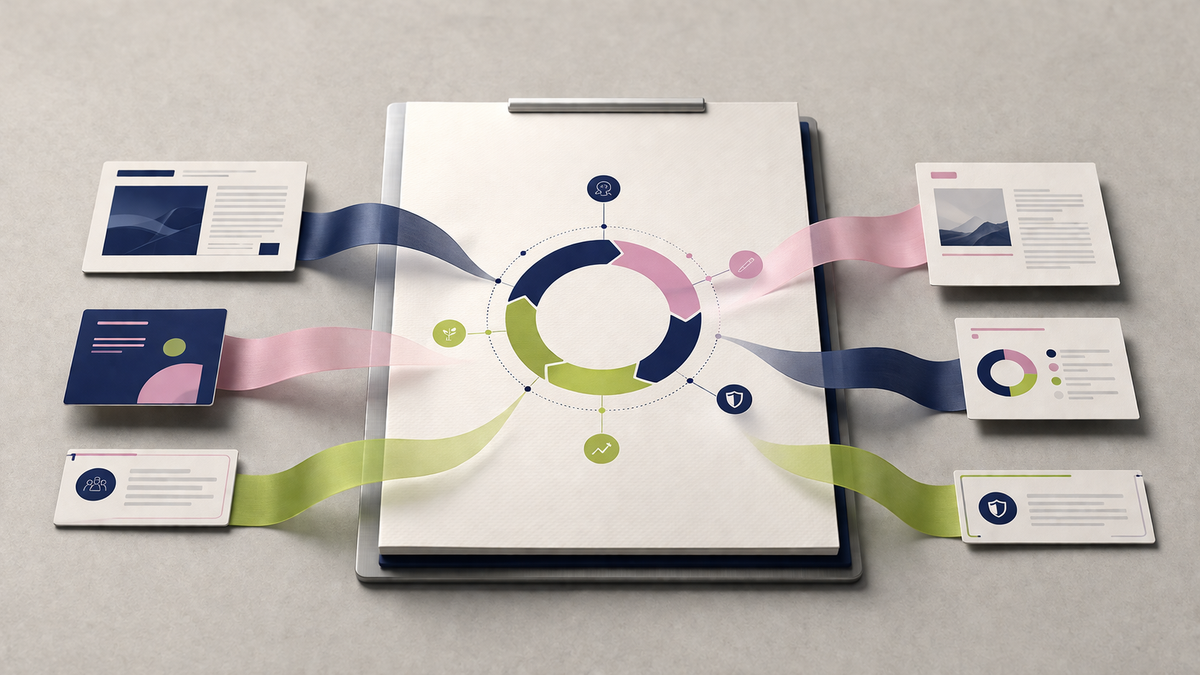
Most conversations about AI in communications live in the Create phase. This is the phase people think of when they think of AI in comms: the press release draft, the LinkedIn post, the blog article, the executive comment, the internal memo. It is the obvious territory, and it is where most teams have already started to experiment.
It is also where the honest conversation about agents is hardest to have.
The temptation with Create is to measure the value of AI by speed. First draft in minutes. Social pack in an afternoon. Campaign assets in a day. Those numbers are real and they matter – I’ve shown what can be done at pace previously – but they describe capacity, not quality. The harder question is whether the work coming out of an agent-assisted production line holds up against the standard senior communicators used to apply to work that took several times longer. Sometimes it does. Often it does not. Knowing the difference is the skill that defines whether a team gets lift from Create-phase agents or drifts into polished mediocrity at scale.
If you missed the earlier articles in this series, the overview introduces the Operating System and its five phases, and Part 2 goes deep on Strategise. This third article is about the phase where most teams meet AI for the first time, and where the judgement calls are most consequential.
The Shape of the Create Phase
Create covers everything that happens between a signed-off strategy and a published asset:
- First-draft production: press releases, bylines, LinkedIn posts, speeches, executive comments, internal announcements, customer communications, statements, and briefings
- Multi-format packaging: translating one piece of thinking into the six to twelve formats a modern campaign needs, with appropriate adjustments for audience, channel, length, and register
- Editorial planning: content calendars, thought leadership plans, campaign timelines, and channel sequencing
- Narrative development: building the connective tissue between individual pieces so a campaign reads as one coherent argument rather than a shopping list of outputs
- Ghostwriting and voice work: producing content in the voice of a specific spokesperson or organisational persona
The thing that unites all of this is that the work is visible. Every Create-phase output has an audience. When quality slips here, it slips in public. That is why the balance between agent capability and human judgement is different in Create from every other phase of the Operating System.
The 35/65 Rule for Create
Across the Operating System, the working rule is roughly 30% AI, 70% human. Create shifts the balance slightly toward AI: 35% AI, 65% human.
Agents do more of the work in Create than they do in Strategise or Govern because the task shape suits them. First drafts from a defined brief. Multi-format adaptation from a strong master. Structural scaffolding where tone is already set. These are tasks with clear inputs and outputs, where consistency matters, and where volume is a meaningful constraint.
What stays human is the work that makes content worth publishing. Voice. Judgement on nuance. The decision to cut a line that sounds clever but lands wrong. The sense of which sentence is pulling too much weight and needs to be broken into two. The instinct that says this draft is fine but not quite there yet, and the craft to know what to do about it.
The 35/65 split is not about time. It is about the share of the work that previously sat with a human. The human share does not get smaller; it gets more concentrated on the decisions where experience is load-bearing.
Where Agents Change Creative Work
Four applications are worth looking at in detail, because they are where the change in the Create phase is most tangible.
1. Structured first drafts from a strong brief
The difference between a useful agent-generated draft and a useless one is almost always upstream. If the message house is clear, the audience is defined, the call to action is agreed, and the length is set, an agent can produce a first draft that a senior writer can take to final in under an hour. If any of those inputs is vague, the draft will read as if it was written by a committee of none of the right people.
This is why Create-phase agent work is inseparable from Strategise-phase rigour. The teams getting the strongest lift from first-draft agents are the teams that have invested in their upstream work. The teams getting weak results are almost always compensating for thin strategy by asking the agent to fill the gap. It cannot.
The Press Release Structure on CommsWith.AI is built for this workflow: making the upstream inputs explicit, so the agent has something substantive to work with.
Tools that work well here: Claude for nuance and structural reasoning; ChatGPT for speed on familiar formats; Gemini where the work needs to be tied to live data or search results. In my own testing, Claude is the most consistent for drafting that needs to hold a specific voice across several pieces in a row.
2. Multi-format packaging from a master piece
Most communications teams spend a disproportionate amount of time turning one idea into many outputs. A single keynote becomes a press release, three LinkedIn posts, a blog article, an email to members, a talking-points document, and a partner briefing. Each needs its own tone, length, and structure. Each takes time.
Agents are excellent at this task. Given a strong master piece and a format brief, a packaging agent can produce a coherent multi-format set in minutes. The output is rarely final, but it is close enough that the editing time is a fraction of the drafting time. For teams running frequent campaigns, this is the single highest-velocity use of Create-phase agents.
The practical catch: the master piece has to hold up on its own. If it hedges, the derivatives hedge harder. If it buries the point, every format buries the point. Multi-format packaging is a magnifier, not a fixer. Once you’ve done this, produce a checklist for the criteria all outputs must individually meet so that they are fully tailored and optimised for the platform of choice.
3. Voice work and ghostwriting
The least obvious but most interesting application. Senior executives are increasingly expected to have a LinkedIn presence, a speaking profile, and a visible public voice, at a frequency that no real human can sustain without help. Communications teams have always ghostwritten for leaders. Agents are starting to change what that ghostwriting looks like.
A voice-trained agent, given a corpus of a spokesperson’s previous writing, can produce drafts that carry their sentence rhythms, preferred framings, and characteristic phrases. The quality varies enormously. A light prompt gives you a generic executive voice with the spokesperson’s name on it. A deeply worked voice profile, built from a dozen representative pieces with notes on what makes them sound like the person, gets you something that stands up to scrutiny.
The judgement call here is ethical before it is technical. Ghostwriting has always involved a degree of fiction about authorship; agents make that fiction easier to scale and harder to police. Teams using voice-trained agents need a clear internal position on disclosure, review, and when a piece should not be produced at all.
4. Editorial planning and narrative architecture
The fourth application is the most senior and the least discussed. Agents are useful for building editorial plans that hang together as a narrative, rather than as a content calendar with dates attached. Given a six-month positioning objective and a list of input events (earnings days, conferences, product moments, regulatory windows), an agent can produce a sequenced editorial plan that ladders individual pieces back to the strategic goal.
This is closer to strategic work than to drafting, and the balance tilts back toward 25/75 here. The agent’s value is in handling the structural complexity of sequencing a dozen moving parts. The human value is in judging which pieces carry the argument forward and which are filler.
The Monthly Content Calendar Planner on CommsWith.AI is designed to structure this work so the agent’s output is a draft plan rather than a list of dates.
Three Examples From Practice
The following are drawn from real client work, anonymised and simplified.
Example 1: A scale-up scaling founder voice
A Series B software company wanted to triple the volume of its founder’s public writing over six months, to establish her as a credible voice on AI governance in the regulated sectors the company sells into. The comms lead had a two-person team and was already at capacity.
The Create-phase work used a voice-trained agent, built from twelve pieces of the founder’s previous writing and two hours of interview transcript. The agent produced first drafts of LinkedIn posts, byline articles, and speaking abstracts; the comms lead edited them with the founder in thirty-minute sessions rather than the two-hour drafting sessions that had previously been the pattern.
Over six months, published output rose from roughly one piece per fortnight to three per week, across LinkedIn, trade press, and speaking platforms. Share of voice in the founder’s target topic rose measurably; inbound speaking invitations tripled. The founder’s stated view at the six-month review was that the published work still sounded like her, which was the non-negotiable test.
Example 2: A charity responding to a contested news cycle
A national charity found itself unexpectedly at the centre of a fast-moving story about a policy change. Over a seventy-two-hour period, it needed to produce a holding statement, a full position paper, six social variants for different platforms, an all-staff briefing, a partner-network briefing, and three spokesperson Q&A packs for different media tiers.
The Create-phase workload in a traditional setup would have required the team to work twenty-hour days or to cut one of the deliverables. Instead, a packaging agent produced first drafts of every format from an agreed position paper master, within four hours. The team spent the remaining sixty-eight hours on strategic refinement, spokesperson preparation, and the judgement-heavy work of deciding what to say and to whom.
Every published piece was substantially edited by a human before going out. Nothing was published in the first draft the agent produced. But the drafts saved roughly a day and a half of writing time, which was the difference between responding well and responding late.
Example 3: A professional services firm producing a flagship report
A mid-sized professional services firm produced an annual flagship report. The report had historically taken six months, involved twelve internal contributors, and had a production pattern of scope creep, late copy, and last-minute edits that pushed the launch date back two weeks every year.
The Create phase was restructured around three agent applications. A structuring agent produced a detailed outline and chapter scaffolds from the agreed brief before any contributor wrote a word. A drafting agent took each contributor’s raw input and produced a first pass that matched the report’s editorial voice. A packaging agent produced the derivative outputs (executive summary, press release, LinkedIn series, speaking abstracts) from the final report, in parallel with the report’s own production.
The report shipped on time. Internal contributors reported significantly less frustration with the process, because the agent handled the editorial heavy lift that had previously been done by a thinly stretched in-house writer. The quality of the final report was judged by the managing partner to be comparable to previous years; the efficiency gain was roughly five weeks of production time.
The lesson from this example is not that agents replaced the writer. The writer’s role shifted. Less time on initial drafting, more time on structural editing and voice consistency. The quality floor held, and the quality ceiling held.
A Test Your Create Work Should Pass 🧪
Before a piece goes into the Govern phase, run it against the following five questions. These are the questions a senior editor at a national newspaper would ask, stripped of politeness. If the piece fails any of them, it is not ready.
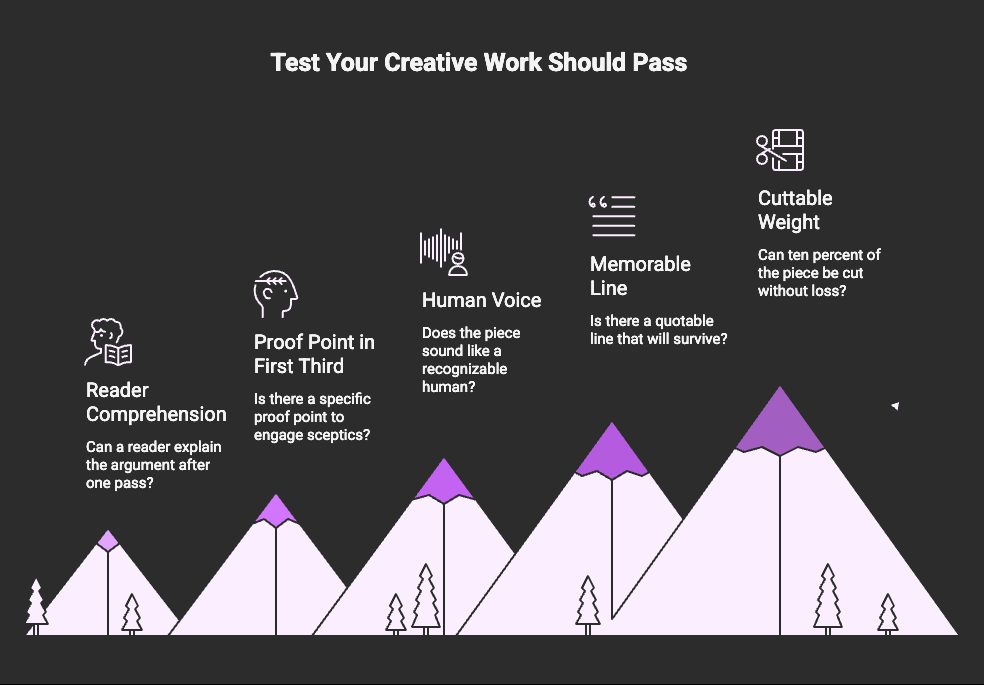
1. Could a reader explain what you are arguing after one pass?
Not after a second read. Not after re-reading the headline. After one pass. If the argument only surfaces on a re-read, the piece is structurally weak. Make the first third do more work.
2. Is there a specific proof point in the first third that stops a sceptic from skimming?
Not a claim. A proof point. A number, a name, a specific example, a verifiable outcome. If the first third is throat-clearing, the piece will not hold the reader long enough to make its case.
3. Does the piece sound like a human you would recognise?
Read it aloud. If three paragraphs in a row could have been written by anyone, the voice has collapsed. Agents are particularly prone to this, because they default to the statistical centre of their training data. Every paragraph needs at least one move that sounds like the author.
4. Is there one line that would survive being quoted back at you in six months?
The best communications work has a line that outlives the campaign. If nothing in the piece is quotable, the piece is probably forgettable. If everything is trying to be quotable, the piece is probably exhausting.
5. What would you cut if you had to lose ten per cent?
Every piece has ten per cent of weight it could lose. If you cannot identify what it is, the piece is over-written and the reader will feel it. If cutting it changes nothing meaningful, cut it.
If the piece passes all five, it is ready to move into Govern. If it fails any of them, the fix belongs in Create, not downstream.
Where To Start
If the Create phase is where your team feels the most volume pressure, three starting points will pay back quickly.
Start with multi-format packaging. It is the clearest demonstration of agent capability, the lowest-risk application, and the fastest time to visible lift. If your team is spending more than a day packaging a single announcement into its full channel set, a packaging agent will pay for itself in the first week.
Build one voice profile, properly. Pick your most active spokesperson. Invest a full day in building a voice profile that holds up. Use it on three pieces, iterate, and extend to a second spokesperson only when the first is working. Voice work done poorly is worse than no voice work at all; done properly, it is one of the highest-leverage Create investments.
Resist the volume trap. The temptation with Create-phase agents is to produce more. The better move is often to produce the same amount and raise the quality floor. Teams that use agents to ship more mediocre content are measurably worse off than teams that use agents to ship the same volume at a higher standard. The metric that matters is not output per week; it is how often a senior leader says the work read like it belonged to the brand.
The templates in the Create phase on CommsWith.AI are built around this logic. Each sits at the intersection of agent capability and human judgement, with prompts and review checklists designed to keep the split in the right place.
Browse the full Create phase on CommsWith.AI.
What Comes Next
Article 4 in this series covers the Govern phase: risk, quality, compliance, and the approval workflows that keep the Create phase from becoming a liability. It is where the 25/75 split kicks in, and where the argument for agent-supported governance is less obvious than it looks.
If your team is working on Create-phase implementation and you want to compare approaches, I am happy to hear from fellow practitioners at michael@faur.site.
About Applied Comms AI
Applied Comms AI is the practical guide for communications leaders navigating AI, grounded in hands-on experimentation, workflow transformation, and real-world implementation. Read the full AI Agent series here.
About Comms With AI
CommsWith.AI is the template and resource library for communications professionals using AI. The Create phase library covers first-draft production, multi-format packaging, voice work, and editorial planning.
About Faur
Faur is a communications consultancy pioneering practical AI expertise for organisations ready to implement at scale. If your team is working on the Create phase and needs bespoke support, voice profile development, workflow redesign, or agent deployment, get in touch.
This article is part of the AI Agent series published on Applied Comms AI. The series maps to the Comms With AI Operating System: Strategise, Create, Govern, Monitor, Transform.